
Global Trade 2025 has defied every expectation. If you spent the last year reading the headlines, you likely expected the economy to be in a state of managed retreat. Instead, the data tells a startlingly different story.
And yet, as the final shipping containers of the year are offloaded in Long Beach, Rotterdam, and Shanghai, the data tells a startlingly different story.
In 2025, global trade didn’t just survive; it shattered records, hitting an eye-watering $35 trillion.
This is the $35 Trillion Paradox. We are trading more than ever before, but we are doing it in a state of perpetual anxiety. The gears of global commerce are turning at high speed, but they are grinding against the grit of geopolitical friction. How did we reach this record high, and why—despite the numbers—does the system feel more fragile than it did a decade ago?
The “Front-Loading” Fever: Buying Tomorrow’s Goods Today
To understand why 2025 was so massive, we have to look at the looming shadow of 2026. If 2025 was the year of “Tariff Turmoil,” it was driven largely by a “Buy Now, Or Pay More Later” mentality.
Throughout the year, the threat of massive, sweeping tariffs—particularly within the U.S. and EU corridors—forced importers into a frantic race. This phenomenon, known as “front-loading,” saw retailers and manufacturers flooding their warehouses with inventory to beat the implementation of new trade barriers slated for January 2026.
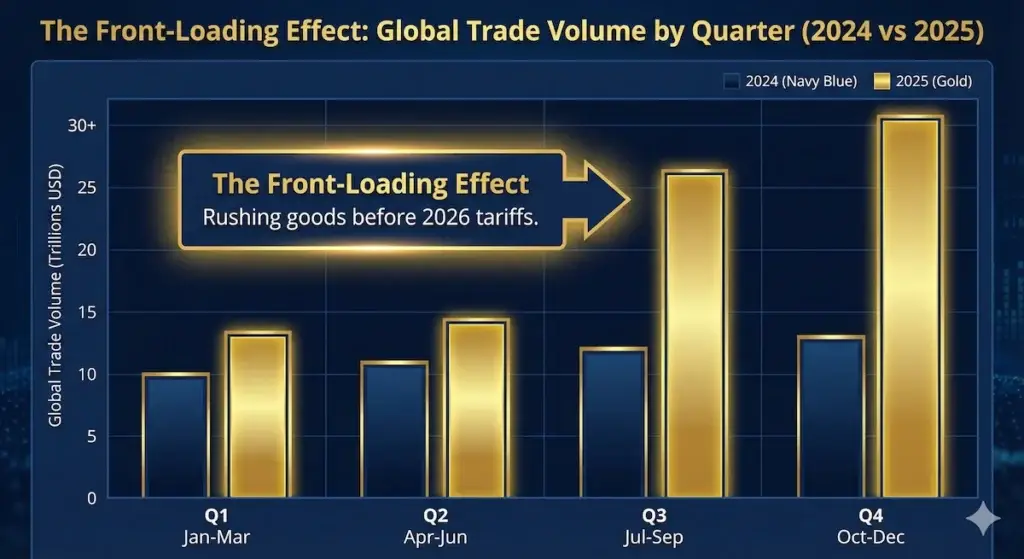
According to analysis from the World Trade Organization (WTO), Global Trade 2025 volume in the first three quarters surged significantly above baseline projections.
Importers effectively “borrowed” volume from 2026 to pad the numbers of 2025. This creates a dangerous illusion of health. While the $35 trillion figure looks impressive on a spreadsheet, much of it represents a “panic buy” on a global scale. When the tariffs finally land in 2026, we should expect a corresponding “bullwhip effect” where volumes crater as warehouses sit full and prices at the shelf begin to climb.
The “South-South” Boom: A New Center of Gravity
Perhaps the most significant structural shift in Global Trade 2025 wasn’t how much we traded, but who was doing the trading.
For nearly a century, the primary engine of global trade was the “North-South” route—developed Western economies importing raw materials from the developing world and exporting finished goods. In 2025, that monopoly officially fractured.
South-South trade—commerce between developing economies—grew by a staggering 8% this year. This growth significantly outpaced the sluggish 1.5% growth seen in traditional Trans-Atlantic and Trans-Pacific routes.
Driven by the expansion of the BRICS+ bloc and the maturing of the African Continental Free Trade Area (AfCFTA), countries in Southeast Asia, Latin America, and Africa are increasingly trading with each other, bypassing traditional Western financial and logistics hubs.
- Vietnam and Mexico have cemented their roles as the “connective tissue” of the global economy, acting as bypass valves for Chinese-Western trade.
- India and Brazil have seen record-high bilateral trade agreements in the energy and agricultural sectors.
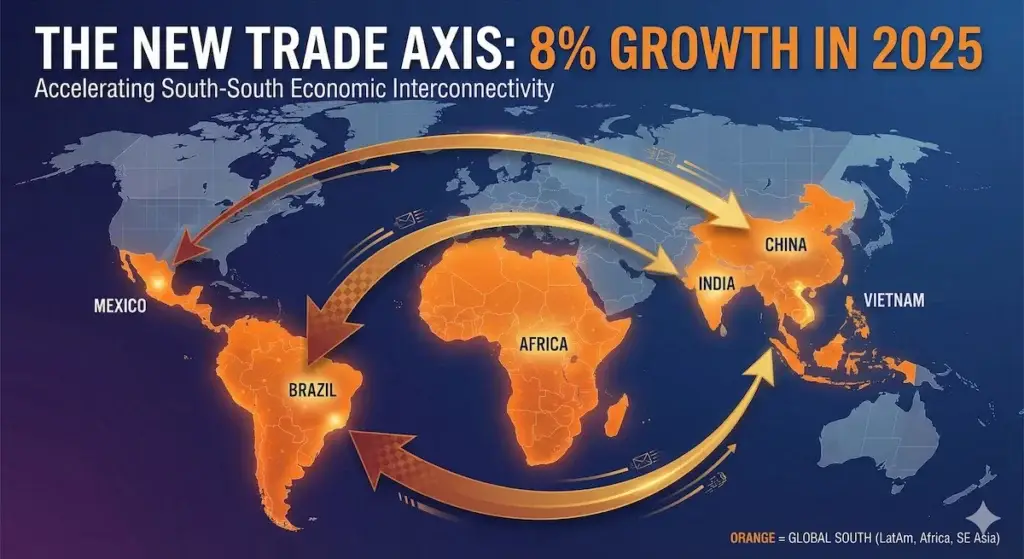
According to the UNCTAD Global Trade Update, this shift is more than just a trend; it is a fundamental re-ordering of the world map. The Global South is no longer just a source of labor or raw materials; it is its own self-sustaining market. However, this “de-coupling” from Western markets adds to the feeling of fragility, as it signals a world where economic interests are no longer a universal glue holding rivals together.
AI as a Survival Tool: The Compliance Revolution
In a year defined by “Tariff Turmoil,” how did businesses manage to keep the lights on? They automated the headache.
As trade rules became more complex in 2025—with daily updates to sanctions lists, carbon border adjustment taxes (CBAM), and shifting tariff schedules—human compliance teams simply couldn’t keep up. This paved the way for the most significant technological leap in logistics history: the mainstreaming of AI in trade.
A landmark report by the International Chamber of Commerce (ICC) revealed that 50% of global firms now utilize AI for trade compliance. This wasn’t about “cool” tech; it was about survival. AI tools are now being used to:
- Automate HS Code Classification: Reducing the risk of costly misfiling and tariff penalties.
- Real-Time Route Optimization: Navigating around geopolitical hotspots like the Red Sea or the Malacca Strait.
- ESG Tracking: Ensuring supply chains comply with increasingly strict environmental laws in the EU.
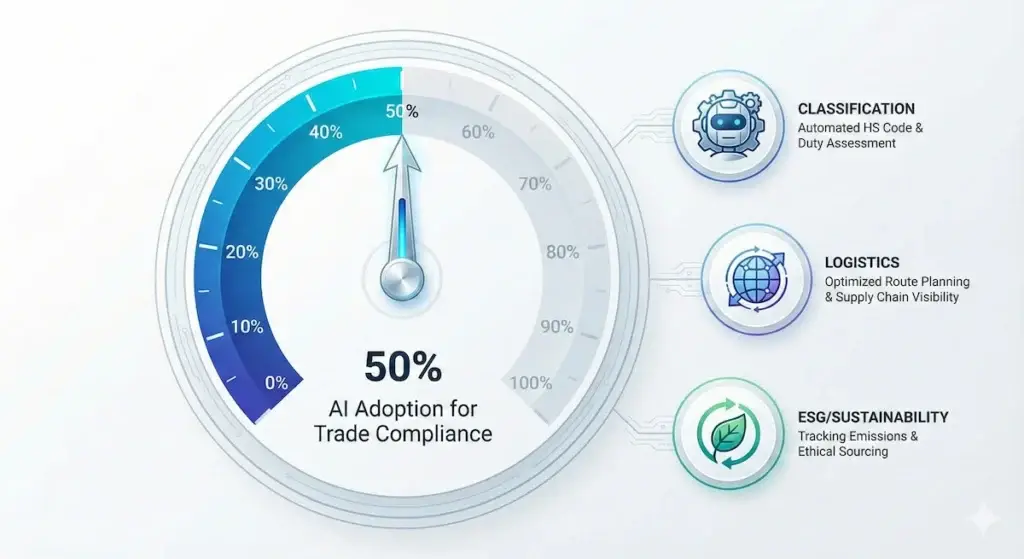
Without AI, the record-breaking figures seen in Global Trade 2025 would likely have been impossible. The sheer friction of modern trade policy would have ground the system to a halt. AI acted as the lubricant that allowed the engine to keep turning, even as the parts began to rust.
The Fragility of Global Trade 2025: Why $35 Trillion Doesn’t Feel Like Success
If we are trading more than ever, why does the global economy feel like it’s walking on eggshells? The answer lies in the quality of the growth.
The $35 trillion total is bolstered by inflation and high energy costs. While the value of trade is at an all-time high, the resilience of the networks is at an all-time low. We have moved from a “Just-in-Time” world to a “Just-in-Case” world, and that transition is expensive.
We are seeing a “dual-track” global economy emerging withing the landscape of Global Trade 2025. On one track, we have the high-tech, AI-driven efficiency of the private sector. On the other, we have the increasingly fractured and protectionist policy of national governments. The gap between these two tracks is where the fragility lives.
The International Monetary Fund (IMF) warned in their Q4 report that the current trade volume is “sustained by temporary factors” and that the underlying geopolitical risks—ranging from the South China Sea to Eastern Europe—could easily trigger a contraction in 2026.
Looking Ahead: The 2026 Hangover?
As we close the books on 2025, the “Year of the Paradox” leaves us with a critical question: Can this momentum be sustained?
History suggests that front-loading is always followed by a dip. The 8% growth in South-South trade is promising, but it cannot entirely replace the purchasing power of the Western consumer in the short term. And while AI has made trade more efficient, it cannot legislate peace or stability.
We should celebrate the $35 trillion milestone as a testament to the incredible resilience of global entrepreneurs. Despite every hurdle thrown in their way—sanctions, tariffs, and regional wars—the world’s traders found a way to move goods. They used AI to cut through the red tape and found new markets in the Global South when the old ones grew cold.
But as we enter 2026, the “Paradox” will likely resolve itself. Either policy will catch up with the reality of our interconnected world, or the friction will finally become too much for even AI to handle.
The $35 trillion record is a trophy, but it’s a glass one. Handle with care.