
Date: December 30, 2025 Category: Trade Agreements / Global Economy
Introduction: A New Year’s Gift for Indian Commerce
Australia India zero tariff exports are set to become a reality as the world prepares to ring in 2026. Indian exporters have received an early celebration notification from Canberra: starting January 1, Australia will eliminate customs duties on 100% of Indian exports.
This milestone, confirmed by India’s Commerce and Industry Minister Piyush Goyal on the third anniversary of the India-Australia Economic Cooperation and Trade Agreement (ECTA), marks the culmination of a phased tariff reduction plan that began in late 2022. For the Indian economy, this is not just a statistic; it is an open door for millions of artisans, manufacturers, and farmers.
The Australia-India ECTA: From “Early Harvest” to Full Bloom
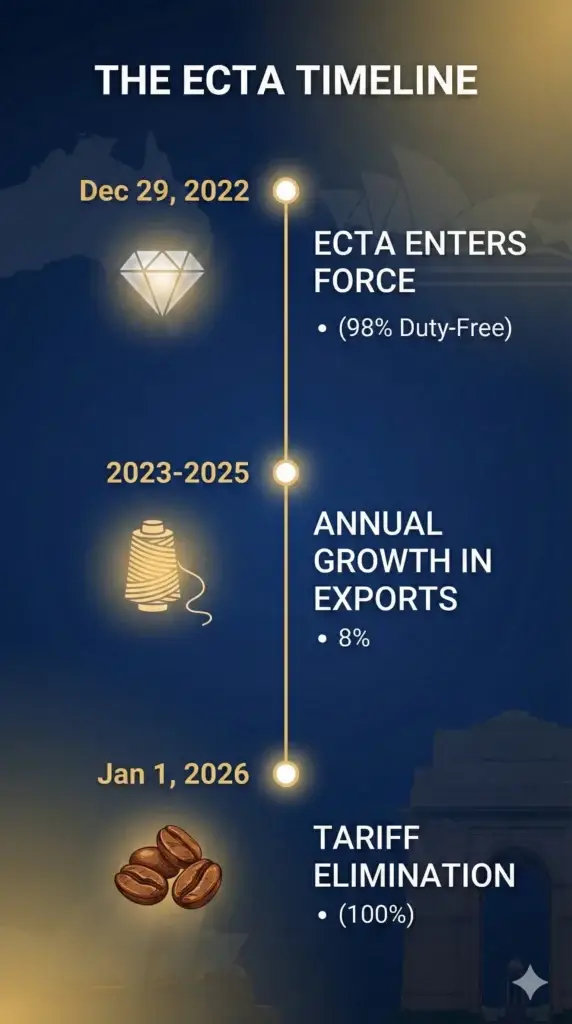
The journey to this zero-duty horizon began on December 29, 2022, when the ECTA first came into force. At that time, it was described as an “early harvest” deal—a diplomatic term for an initial agreement intended to be expanded later.
According to the original terms, Australia offered immediate duty-free access to about 98% of Indian exports by value. However, the remaining 2%—often covering sensitive or complex tariff lines—were subjected to a phased reduction over five years.
What changes on January 1, 2026?
As per the latest announcement reported by The Hindu, the final tranche of tariffs will be wiped out. This ensures Australia India zero tariff exports for every single product originating from India, be it a handcrafted rug from Bhadohi or a precision-engineered auto component from Chennai, will enter Australia without paying a cent in customs duty.
“From January 1, 2026, 100% of Australian tariff lines will be zero-duty for Indian exports,” Minister Goyal stated, highlighting that the agreement has already delivered sustained export growth and deeper market access over the last three years.
Who Benefits?
The removal of these final tariffs is expected to disproportionately benefit labor-intensive sectors, which are the backbone of India’s employment data:
- Textiles and Apparel: Australian fashion retailers can now source Indian cotton and synthetics more cheaply than competitors still facing tariffs.
- Gems and Jewellery: Already seeing a 16% rise in exports between April-November 2025, this sector stands to gain further margins.
- Agricultural Products: Broad-based growth has been recorded in coffee, marine products, and spices. The zero-duty regime makes Indian produce highly competitive against imports from South America or Southeast Asia.
The Wider Trend: Australia India Zero Tariff Exports & Beyond
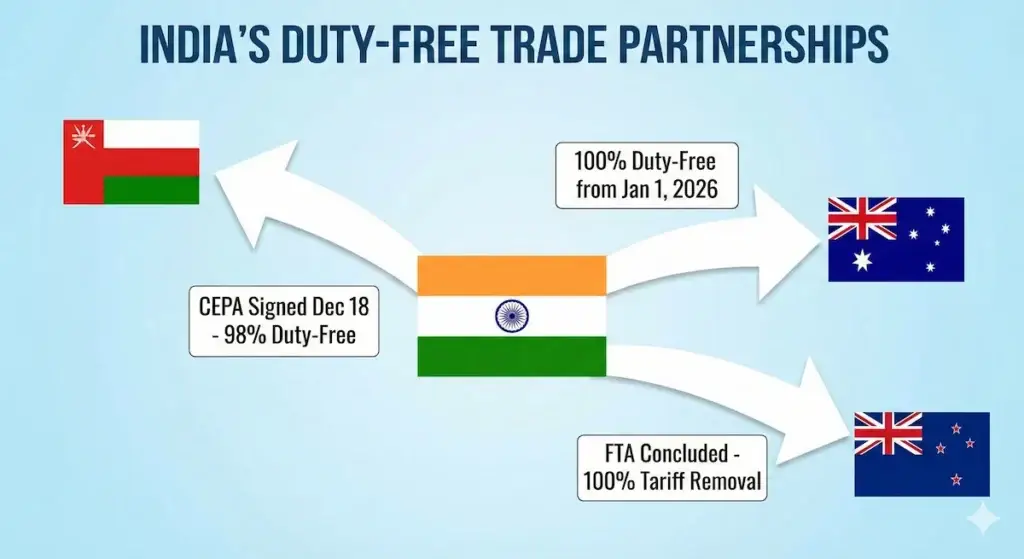
While the Australian announcement is the headline of the week, it is not an isolated event. December 2025 has proven to be a historic month for Indian trade diplomacy, with similar breakthroughs achieved with New Zealand and Oman.
1. The New Zealand Parallel
Just days prior to the Australian announcement, India and New Zealand concluded negotiations for a Free Trade Agreement (FTA) that mirrors the Australian model. Reports confirm that once implemented, this deal will mirror the Australia India zero tariff exports model, providing similar duty-free access to 100% of goods.
This is particularly significant for India’s pharmaceutical and IT sectors. New Zealand, often seen as a gateway to the wider Pacific, has traditionally maintained high standards for imports. By eliminating tariffs, Kiwi businesses are effectively incentivized to diversify their supply chains away from traditional East Asian hubs and look toward India. The forecast suggests bilateral trade between India and New Zealand could double to $5 billion within five years.
2. The Oman Gateway (Gulf Cooperation)
Adding to the momentum, India signed a Comprehensive Economic Partnership Agreement (CEPA) with Oman on December 18, 2025. This deal is strategic, granting near-universal duty-free access (approx. 98% of tariff lines) for Indian goods entering the Gulf nation.
While the Australia and New Zealand deals focus heavily on finished goods and services, the Oman agreement is pivotal for energy security and re-exports. Oman serves as a critical logistics hub; duty-free Indian goods can enter Oman and potentially be re-routed to other parts of the Middle East and Africa with lower overheads.
Economic Analysis: Why “Zero-Duty” Matters
Why is the number “100%” so important? In international trade, even a small tariff of 2.5% or 5% can erase a manufacturer’s profit margin, especially in high-volume, low-margin industries like textiles or steel.
By finalizing Australia India zero tariff exports, the nation effectively integrates its manufacturing floor with Australian consumption.
- Leveling the Playing Field: Indian exporters have long competed with nations like Vietnam and Bangladesh, which enjoy various preferential trade statuses. This agreement neutralizes that disadvantage in the Australian market.
- Supply Chain Resilience: For Australia, this is about reducing over-reliance on a single manufacturing giant. By making Indian goods cheaper, Canberra is practically funding its own supply chain diversification strategy.
- Boost for MSMEs: Large corporations have the margins to absorb tariffs; Micro, Small, and Medium Enterprises (MSMEs) do not. This zero-duty regime is essentially a direct subsidy to India’s smallest exporters, allowing them to price their goods competitively on global shelves.
The Road Ahead: CECA and Beyond
While the ECTA (Economic Cooperation and Trade Agreement) has reached its zenith with this tariff removal, it is technically an interim agreement. The “main course”—the Comprehensive Economic Cooperation Agreement (CECA)—is still under negotiation.
CECA is expected to cover deeper issues such as digital trade, government procurement, and more complex services regulations. However, the success of ECTA serves as a massive confidence booster. If the two nations can successfully implement a 100% tariff removal without disrupting domestic industries, the more complex negotiations of CECA become significantly easier to navigate.
Conclusion
As the sun rises on 2026, the trade winds between India and the Indo-Pacific are blowing stronger than ever. The success of Australia India zero tariff exports is a testament to a trade relationship that has matured rapidly from tentative talks to full-fledged economic integration.
For the global observer, this trio of agreements with Australia, New Zealand, and Oman signifies India’s arrival as a serious, open-market player. For the Indian exporter, the message is simpler and far more profitable: The world is open for business, and the entry fee has just been waived.
References
- The Hindu: Australia to remove tariffs on 100% of Indian exports from January 1
- Times of India: All exports to get duty-free access to Australia
- Press Information Bureau: India-New Zealand FTA Concluded