
After more than 25 years of stop-start negotiations, the European Union has officially given the green light to the EU-Mercosur trade deal. In a decisive move on Friday, January 9, EU member states voted by a qualified majority to approve the pact, overriding fierce opposition from France and a bloc of dissenting nations.
This massive agreement creates one of the world’s largest free trade zones, linking the European market with the South American powerhouse economies of Brazil, Argentina, Paraguay, and Uruguay. But while Brussels and Berlin are celebrating a geopolitical win, the mood in Paris and Dublin is far more somber.
Here is a deep dive into what just happened, what is in the deal, and why it remains so controversial.
The Breakthrough: How the EU-Mercosur Trade Deal Happened
The road to this deal has been long and winding, dating back to 1999. For years, it seemed dead in the water, bogged down by environmental concerns and protectionist hurdles. However, the deadlock was finally broken this week.
According to sources cited by the Wall Street Journal, the agreement passed via a “qualified majority” vote. This mechanism allowed the deal’s supporters—led by Germany and Spain—to bypass the veto power of opposing nations. The tipping point came when Italy reportedly threw its weight behind the deal, leaving France, Poland, and Ireland without enough votes to form a blocking minority.
“Cars for Cows”: What is in the Deal?
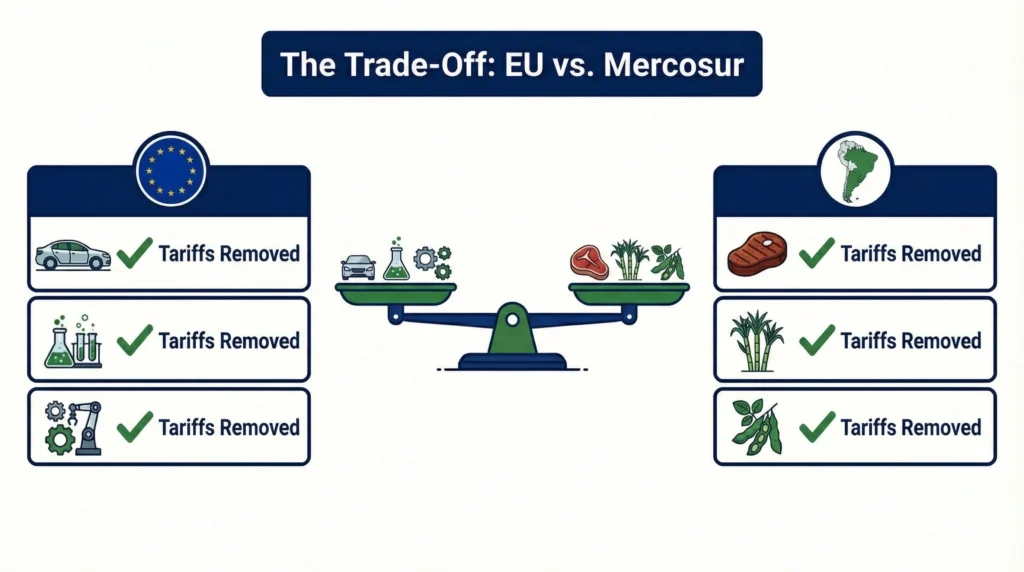
At its heart, the EU-Mercosur trade deal is a classic exchange of industrial access for agricultural opportunity. The agreement aims to eliminate duties on roughly 90% of trade between the two blocs, covering a market of over 700 million people.
What Europe Gains
For the EU, this is about securing export markets for its industrial base. European manufacturers will see tariffs slashed on:
- Automotive: Duties on European cars (currently up to 35%) will be phased out.
- Machinery & Chemicals: Easier access for industrial goods and pharmaceuticals.
- Services: European firms will gain access to lucrative government contracts in South America.
What South America Gains
For the Mercosur nations, the prize is access to the wealthy European Single Market for their agricultural giants:
- Beef & Poultry: The deal opens a quota for 99,000 tonnes of beef to enter the EU at preferential rates (7.5%), along with increased access for poultry.
- Sugar & Ethanol: Expanded export opportunities for these key commodities.
Proponents argue this is vital for the EU’s economy, potentially adding billions to the GDP and diversifying supply chains away from reliance on China.
The Backlash: Why France is Furious
While the champagne may be flowing in Brussels, the reaction in rural Europe is explosive. French President Emmanuel Macron has led the charge against the EU-Mercosur trade deal, calling it ‘outdated’ and warning it threatens Europe’s food sovereignty.
The Level Playing Field Argument
European farmers are subject to some of the strictest environmental and animal welfare regulations on the planet. They argue that importing cheaper beef, sugar, and poultry from South America—where production costs are lower and standards differ—creates unfair competition. As reported by Reuters, farmer protests have already intensified across France and Belgium in anticipation of this vote.
Environmental Anxieties
The other major sticking point is the Amazon. Environmental groups and Green parties across Europe fear the deal will incentivize deforestation to clear land for cattle and soy. To counter this, the EU Commission has included a “sustainability annex” with binding commitments to the Paris Agreement, but critics argue these safeguards lack teeth.
What Happens Next?
This is where the opposition will make its final stand. French lawmakers across the political spectrum have vowed to vote it down. If the European Parliament rejects the EU-Mercosur trade deal, we could be back to square one.
This is where the opposition will make its final stand. French lawmakers across the political spectrum have vowed to vote it down. If the European Parliament rejects the deal, we could be back to square one.
For now, the EU has signaled it is open for business. Whether this deal becomes a pillar of global trade or a flashpoint for European unity remains to be seen.