
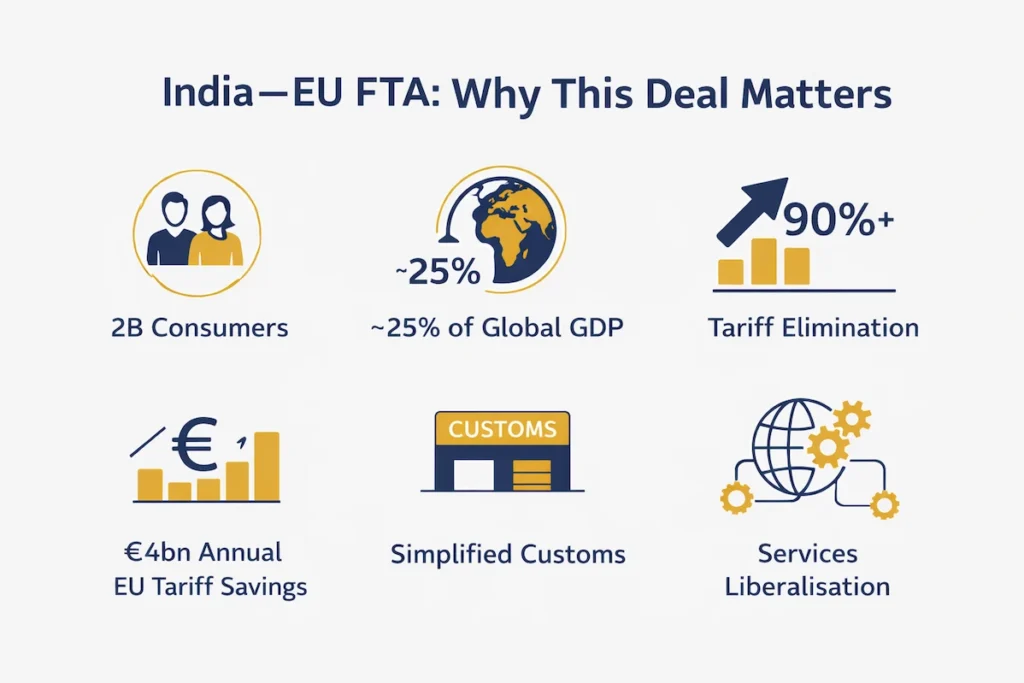
On 27 January 2026, India and the European Union formally signed what both sides have described as the “Mother of All Trade Deals”—a comprehensive India EU Free Trade Agreement covering goods, services, investment facilitation, customs cooperation, and regulatory alignment. With India and the EU together accounting for roughly one-quarter of global GDP, this agreement is not merely bilateral in impact; it is systemic in nature.
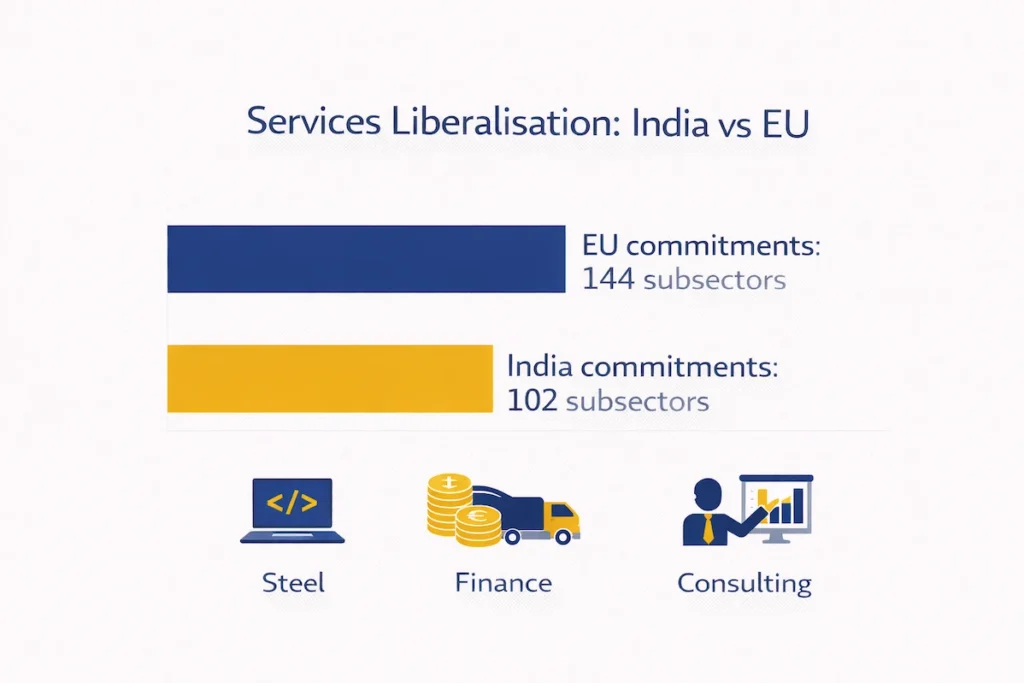
According to official summaries from the European Commission and India’s Ministry of Commerce, the agreement eliminates or reduces tariffs on over 90% of traded goods, liberalizes services across more than 240 subsectors, and introduces simplified customs procedures aimed at reducing friction across supply chains (European Commission, Government of India).
This article examines who benefits, how supply chains will reorganize, and what this deal means for the rest of the world.
Why This Deal Is Structurally Different From Past FTAs
Most trade agreements focus narrowly on tariff reduction. The India EU free trade agreement goes significantly further by addressing how goods are produced, certified, transported, and serviced.
Key structural elements include:
- Tariff elimination on ~90–97% of tariff lines, phased over 7–10 years
- Self-certification of origin (Statement on Origin) to reduce customs delays
- Alignment on technical standards (TBT) and food safety (SPS)
- Market access commitments in services, including IT, finance, maritime, and professional services
Reuters notes that EU exporters alone could save up to €4 billion annually in tariff costs, while Indian exporters gain preferential access to one of the world’s highest-value consumer markets (Reuters).
Economic Benefits for India
1. Export Competitiveness in Labour-Intensive Sectors
India’s strongest gains are concentrated in sectors where tariffs previously acted as a price ceiling:
- Textiles & apparel
- Leather & footwear
- Gems & jewellery
- Marine products
- Toys and sports goods
According to India’s official deal factsheet, nearly 99.5% of India’s exports by value receive preferential access to the EU market (Ministry of Commerce).
This positions India as a natural beneficiary of EU sourcing diversification, especially as European firms seek alternatives to concentrated supply chains.
2. MSME Integration Into European Supply Chains
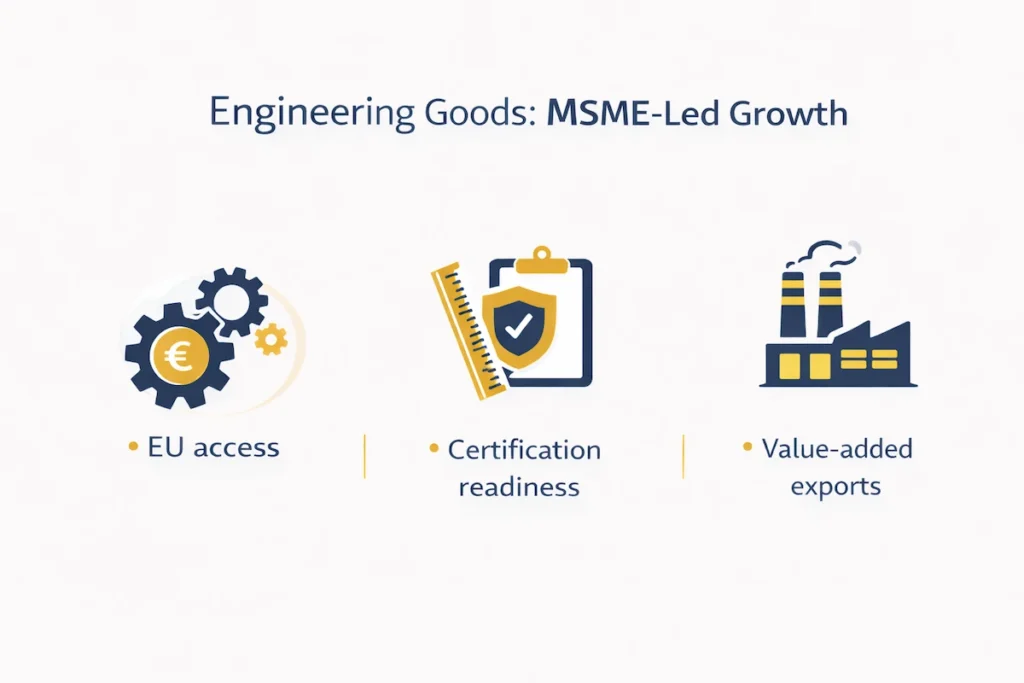
The introduction of simplified rules of origin and digital customs procedures lowers entry barriers for Indian MSMEs.
Instead of navigating complex third-party certification, exporters can now self-declare origin, reducing both cost and time to market. This is particularly impactful for tier-2 and tier-3 suppliers attempting to plug into European procurement networks.
3. Services and Digital Trade Expansion
India gains access to 144 EU services subsectors, including IT services, professional services, financial services, and maritime logistics. This supports a growing trend of “embedded trade”, where services move alongside goods.
In practice, this means Indian firms increasingly provide:
- Design and engineering support
- Compliance documentation
- After-sales services
- Digital supply-chain analytics
Economic Benefits for the European Union
1. Entry Into a High-Growth Market
India is projected to remain one of the fastest-growing large economies through the late 2020s (IMF, World Economic Outlook). The FTA gives EU exporters preferential access to a market of 1.4 billion consumers.
Key beneficiaries include:
- Machinery and electrical equipment
- Chemicals and pharmaceuticals
- Medical devices
- Select agri-food products
2. Lower Cost of Capital Goods
By reducing Indian tariffs on EU machinery and industrial equipment, the agreement indirectly improves India’s manufacturing productivity—benefiting EU suppliers while strengthening long-term bilateral value chains.
3. Services Liberalization
The EU gains improved access to Indian markets in:
- Financial services
- Maritime and logistics
- Professional services
This supports EU firms seeking to scale operations across South Asia.
How the Deal Reshapes Global Supply Chains
A Shift From “China-Centric” to “India-Integrated” Models
While China remains deeply embedded in global manufacturing, the India EU free trade agreement strengthens India’s position as a credible alternative manufacturing and sourcing hub, particularly for Europe.
Key supply-chain shifts include:
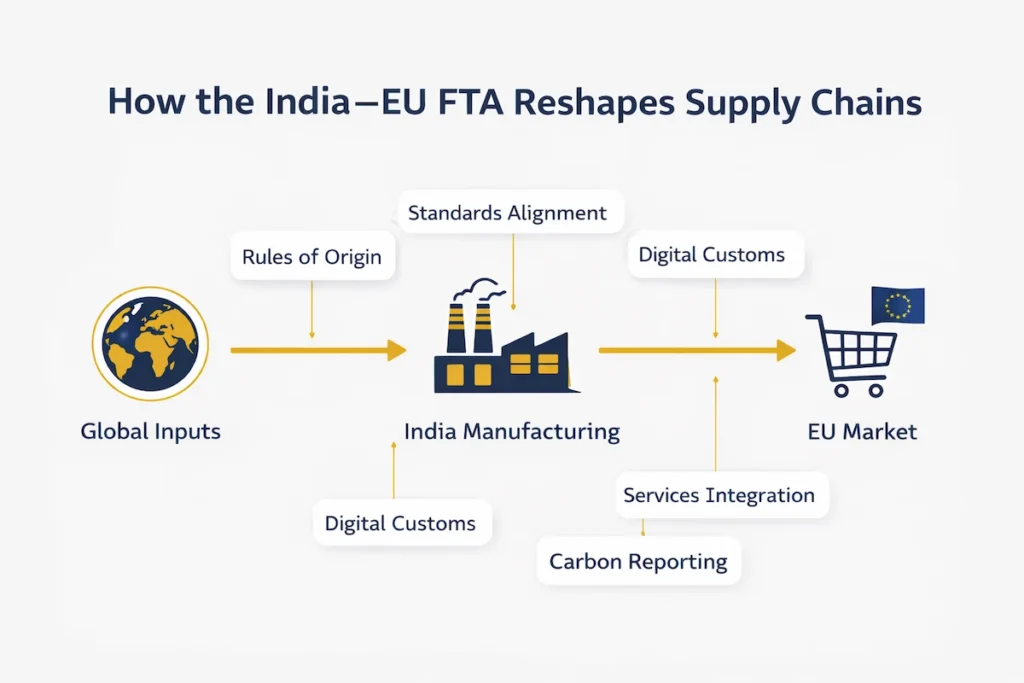
- Increased two-stage manufacturing (EU inputs → Indian processing → EU market)
- Greater use of India for mid-value manufacturing and assembly
- Higher emphasis on compliance, traceability, and sustainability
Standards Become the New Tariffs
Tariffs may fall, but standards rise.
The India EU free trade agreement emphasizes cooperation on:
- Product conformity
- Environmental and safety regulations
- Digital documentation
Export success will increasingly depend on documentation quality, carbon reporting, and audit readiness, not just pricing.
Sector-Wise Impact Overview
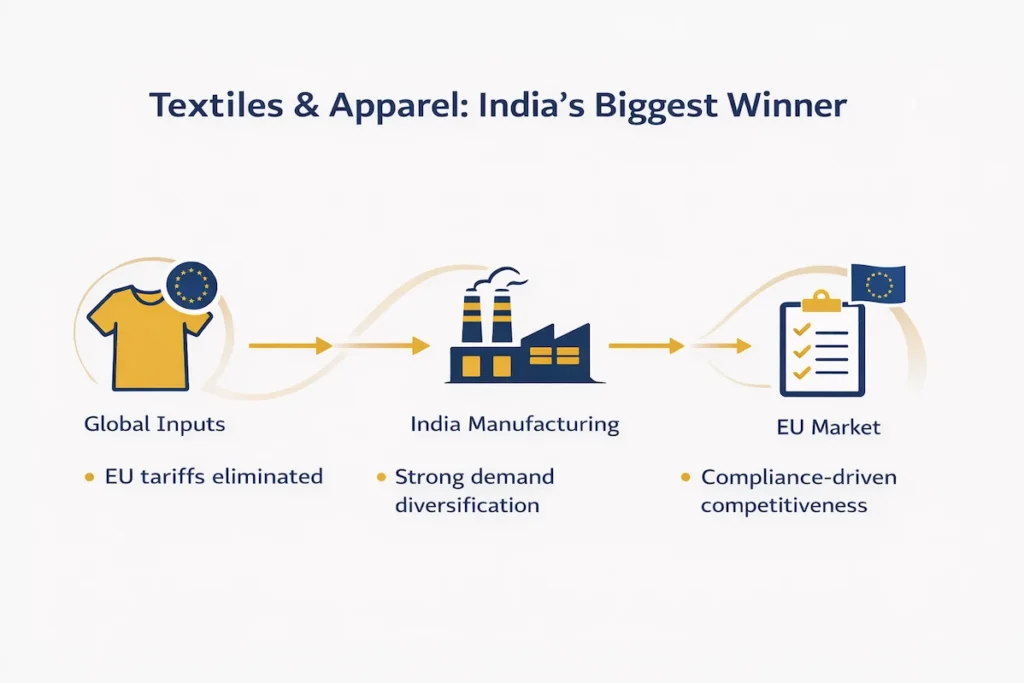
Textiles & Apparel
Impact: Strong positive
Driver: Tariff elimination + EU sourcing diversification
Risk: Rules of origin compliance
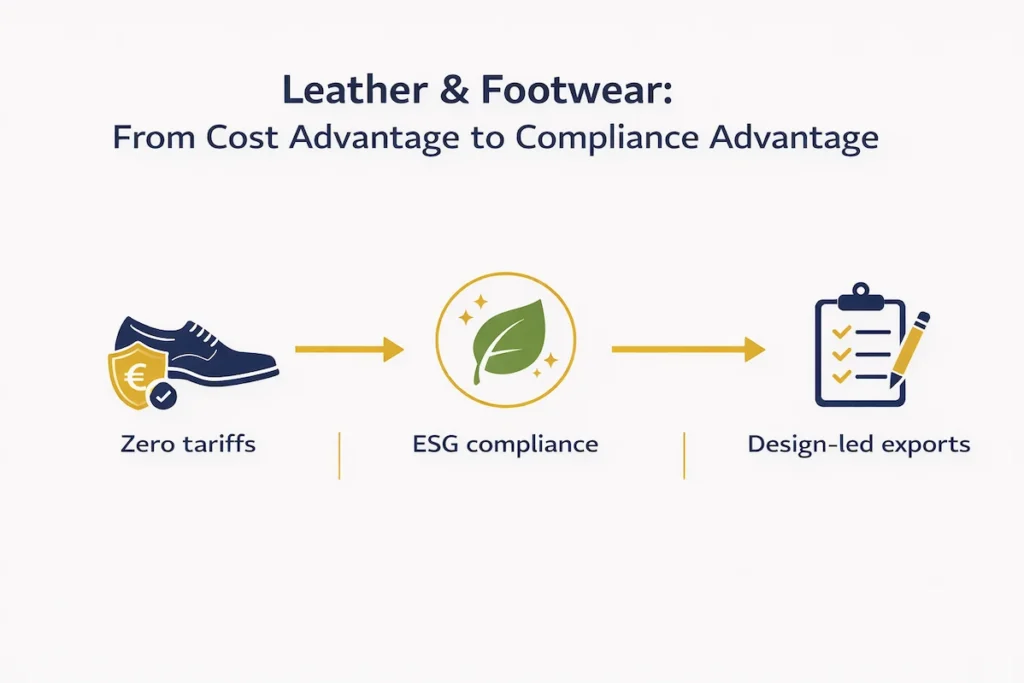
Leather & Footwear
Impact: Strong positive
Driver: Improved price competitiveness
Risk: ESG and sustainability standards
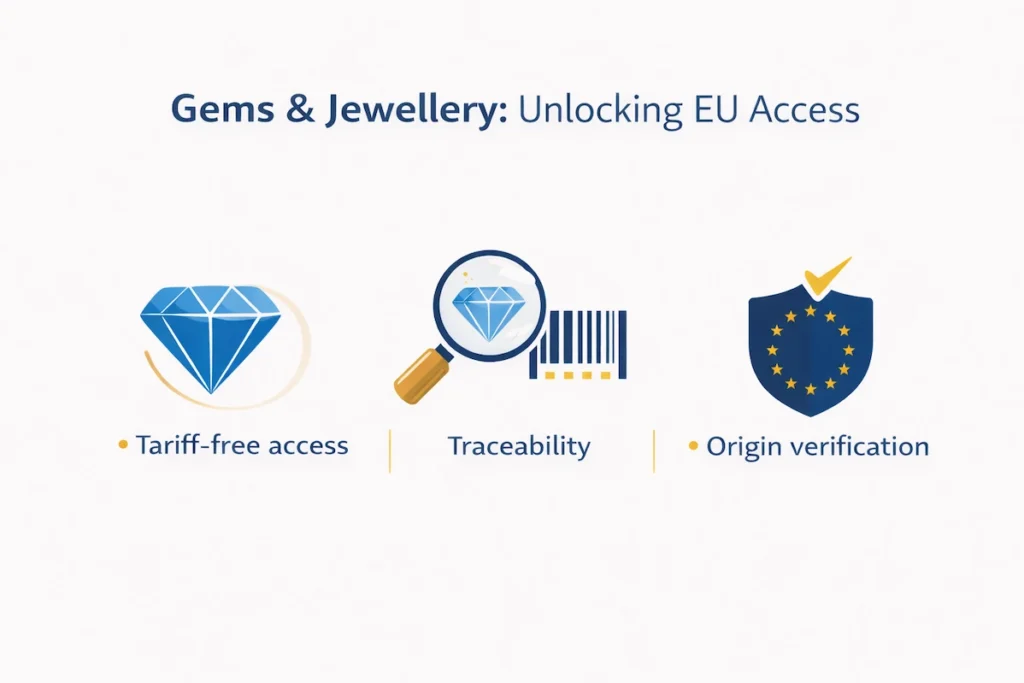
Gems & Jewelry
Impact: Tariff-free access
Driver: Traceability
Risk: Origin verification
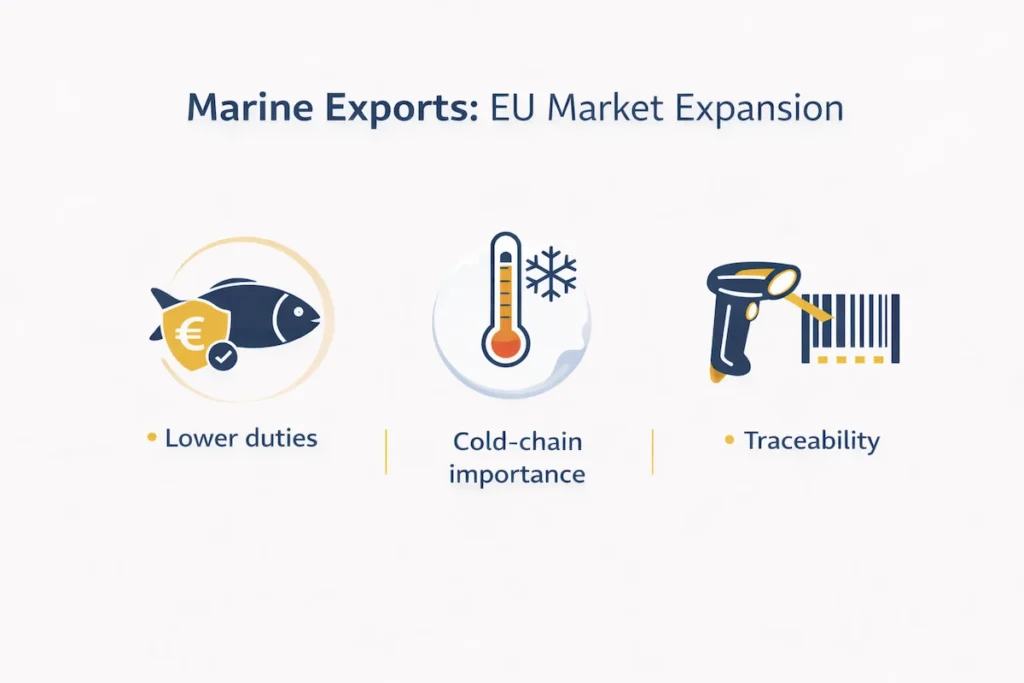
Marine & Seafood
Impact: Lower duties
Driver: Cold-chain importance
Risk: Traceability
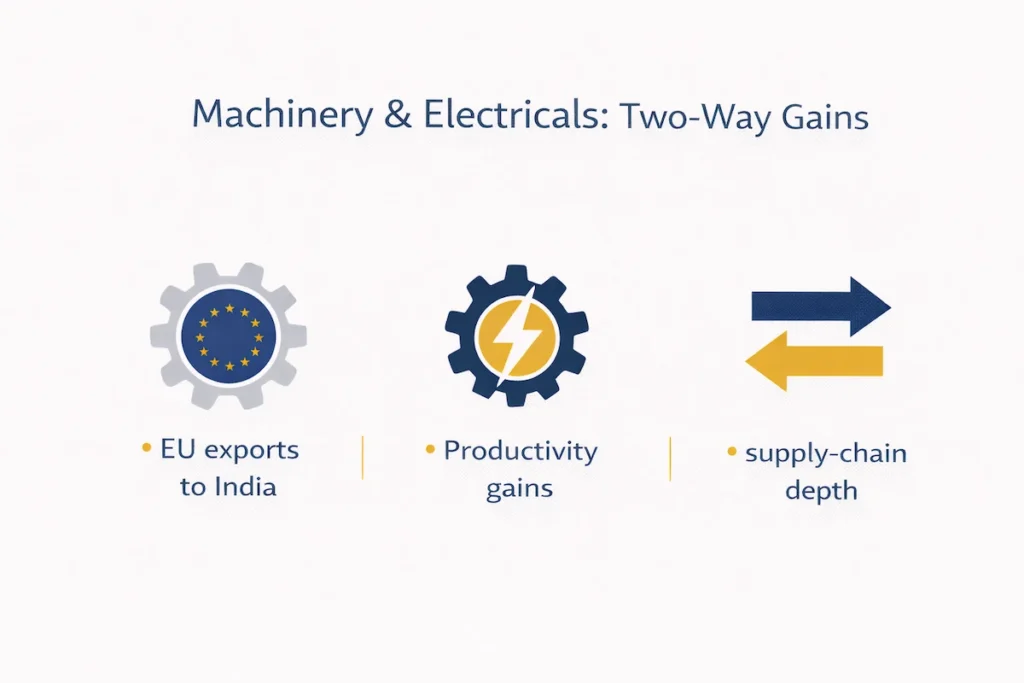
Machinery & Electricals
Impact: EU export to India
Driver: Productivity gains
Risk: Supply chain depth
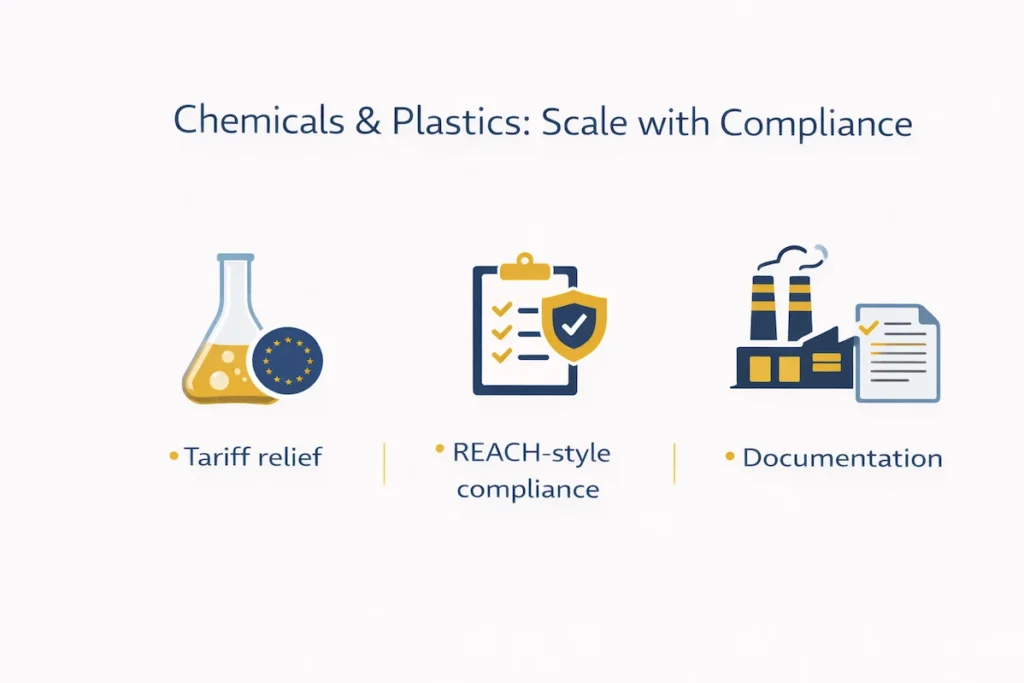
Chemicals & Plastics
Impact: Moderate to strong
Driver: Scale expansion
Risk: Regulatory documentation
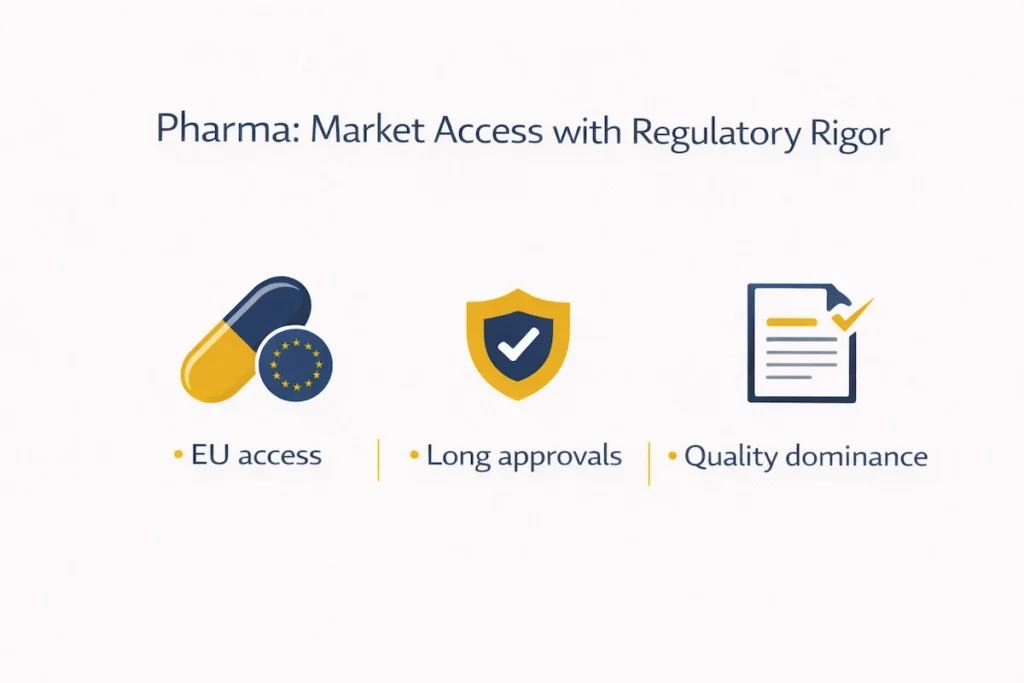
Pharmaceuticals & Medical Devices
Impact: Moderate
Driver: Market access
Risk: Lengthy approvals
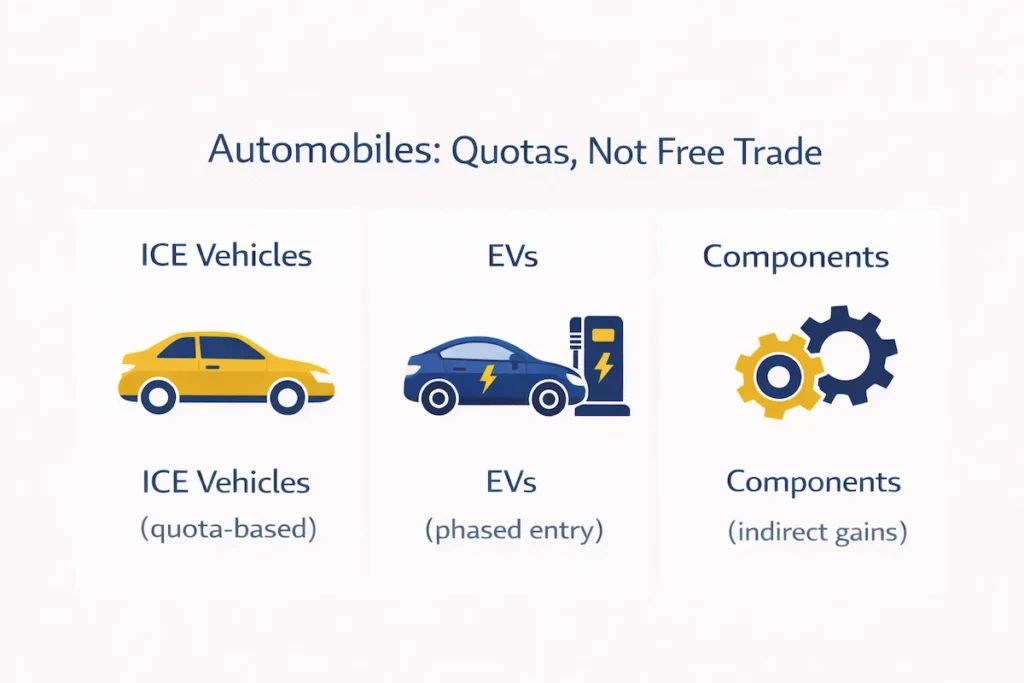
Automobiles
Impact: Selective
Driver: Quota-based tariff reductions
Risk: Limited volumes, phased access
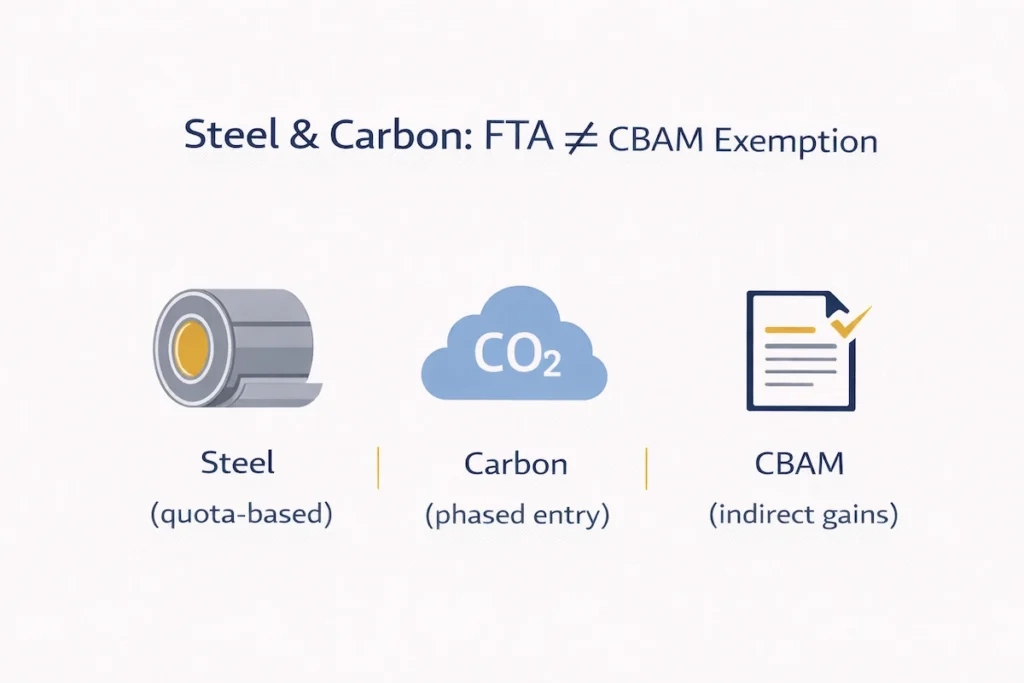
Steel & Carbon-Intensive Industries
Impact: Mixed
Driver: Trade access
Risk: EU Carbon Border Adjustment Mechanism (CBAM) still applies (Reuters)
Global Impact: What It Means for the Rest of the World
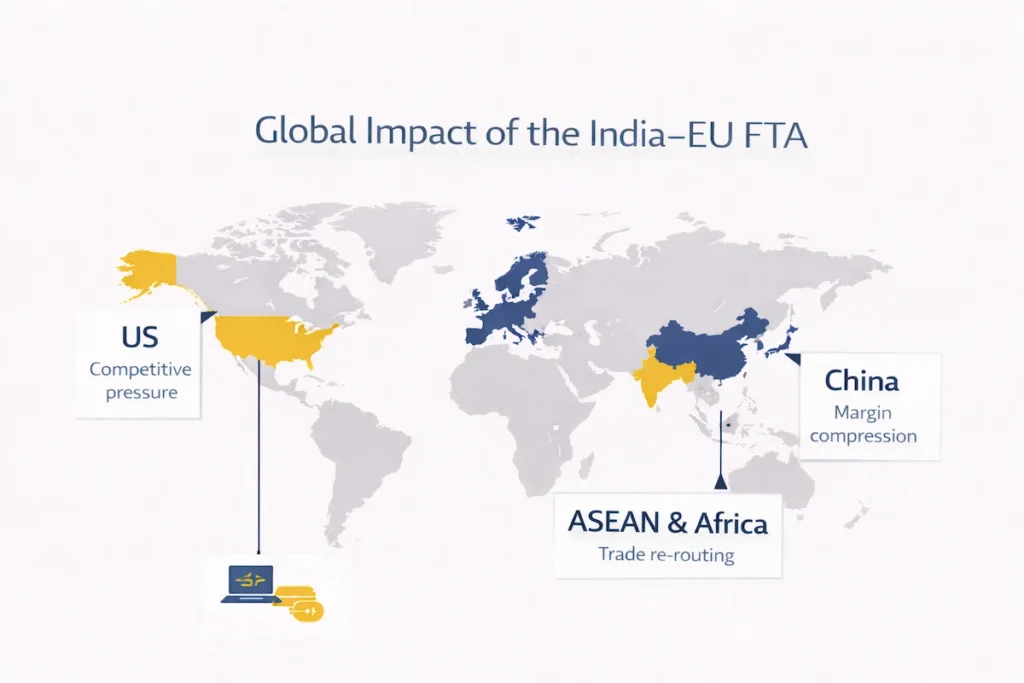
Because the India–EU bloc represents roughly 25% of global GDP, trade diversion effects are unavoidable.
United States
- Faces increased competition in EU and Indian markets
- May accelerate bilateral or plurilateral trade initiatives
China
- Not displaced overnight, but margin pressure increases
- India becomes a stronger alternative for EU sourcing in select sectors
ASEAN, UK, Africa
- May benefit as intermediate suppliers or logistics hubs
- Risk preference erosion in EU markets
The WTO has long noted that mega-regional trade agreements tend to reshape trade flows beyond their signatories (WTO).
Key Takeaways
As the India EU free trade agreement moves toward implementation, businesses and policymakers alike will need to adapt to new rules, standards, and supply chain realignments.
- This is not just a tariff deal; it is a supply-chain architecture agreement
- India gains export competitiveness and deeper global integration
- The EU gains access to a high-growth market and tariff savings
- Compliance, standards, and carbon accounting will define winners
- Global trade patterns will gradually realign around the India–EU corridor
Final Thought
The India–EU FTA marks a decisive shift toward rules-based, resilience-driven globalization. For businesses, the question is no longer whether trade will grow—but who adapts fastest to the new operating rules.