
In the timeline of every nation, there are moments that signify a permanent shift in identity. For the United Arab Emirates, 2025 was that year. For decades, global observers have viewed the Gulf through the lens of crude oil barrels and energy prices. But today, the narrative has fundamentally changed.
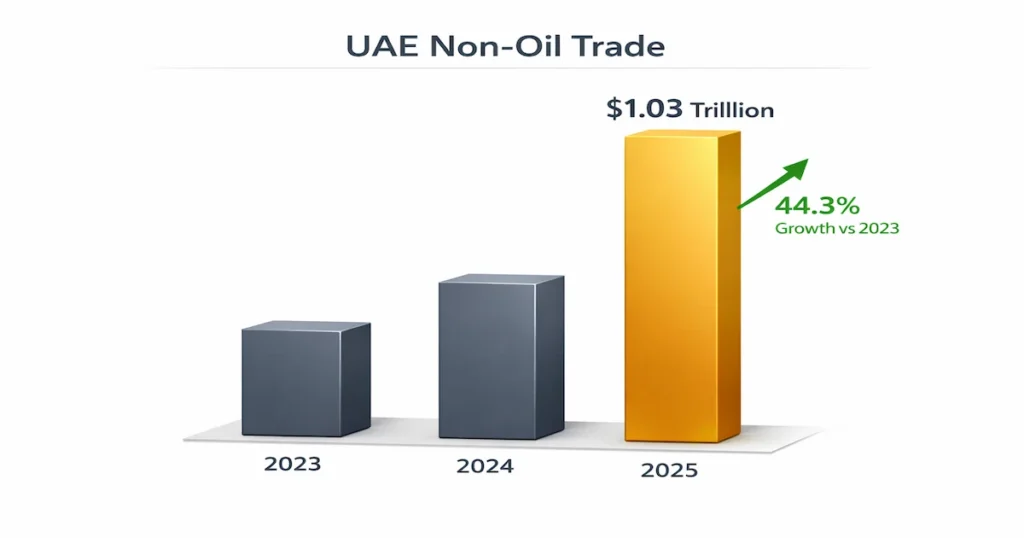
For the first time in its history, the UAE non-oil foreign trade has crossed the AED 3.8 trillion ($1.03 trillion) mark, effectively shattering the “petro-state” stereotype and establishing the Emirates as a diversified global trade super-connector [Times of India].
This isn’t just a win for the local economy; it is a signal to global investors that the UAE’s “post-oil” future isn’t a distant dream—it is already here.
The Numbers That Shook the Region
The scale of this achievement is difficult to overstate. According to official data released by His Highness Sheikh Mohammed bin Rashid Al Maktoum, Vice President and Prime Minister of the UAE, the country didn’t just inch past the trillion-dollar mark; it surged past it with momentum. WAM (Emirates News Agency)
The year 2025 saw a 27% increase in non-oil trade compared to 2024, and a massive 44.3% jump compared to 2023 [Government of Dubai Media Office]. To put this in perspective, most developed economies celebrate trade growth in the single digits. The UAE is delivering double-digit acceleration in a global climate often defined by supply chain uncertainty.
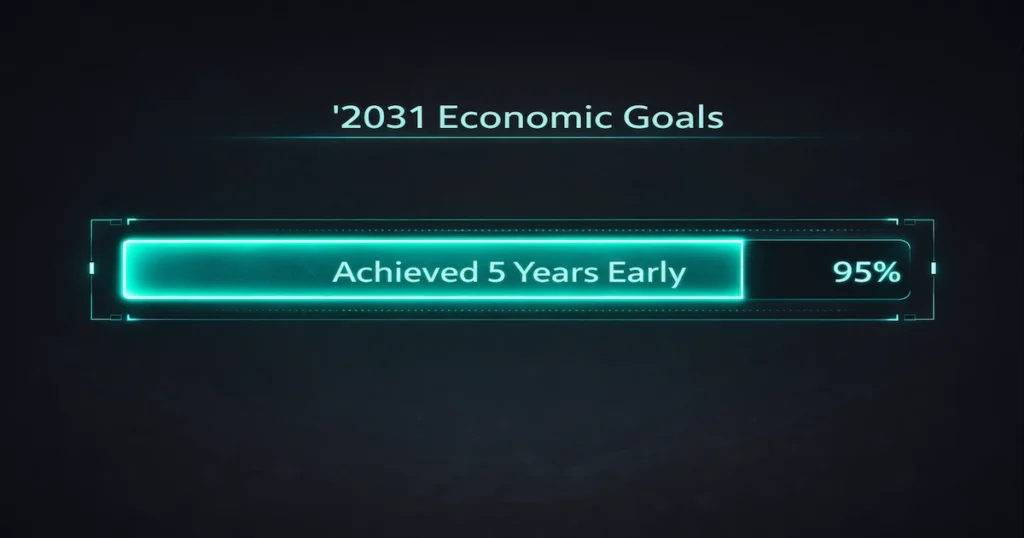
Perhaps the most staggering statistic is the sheer speed of execution. As reported by the Times of India, the trade volumes achieved in 2025 were originally the targets set for 2031.
“We have achieved 95% of the targets of the ‘We the UAE 2031’ economic national charter… five years ahead of schedule,” Sheikh Mohammed noted in his address to the nation [Times of India].
Beyond Re-Exports: A Nation of “Makers”
Historically, trade hubs like Dubai built their wealth on “re-exports”—importing goods and shipping them out again. While re-exports remain a vital pillar of the economy, the 2025 report highlights a critical evolution: the UAE is becoming a manufacturing powerhouse.
The star of this economic report is UAE non-oil foreign trade, which reached AED 813.8 billion ($221.5 billion).
- Growth Rate: This sector grew by 45.5% in a single year.
- Economic Shift: In 2019, domestic exports made up only 14.1% of the UAE’s total trade. Today, that figure has risen to 21.6%, according to Gulf Business analysis.
This indicates a structural change in the economy. The UAE is no longer just a transit point for other people’s products; it is adding value, manufacturing, and exporting its own goods to the world.
What is the UAE Selling to the World?
If it’s not oil, what is filling these thousands of shipping containers? The export portfolio has become remarkably diverse, insulating the economy from volatile price swings in any single commodity.
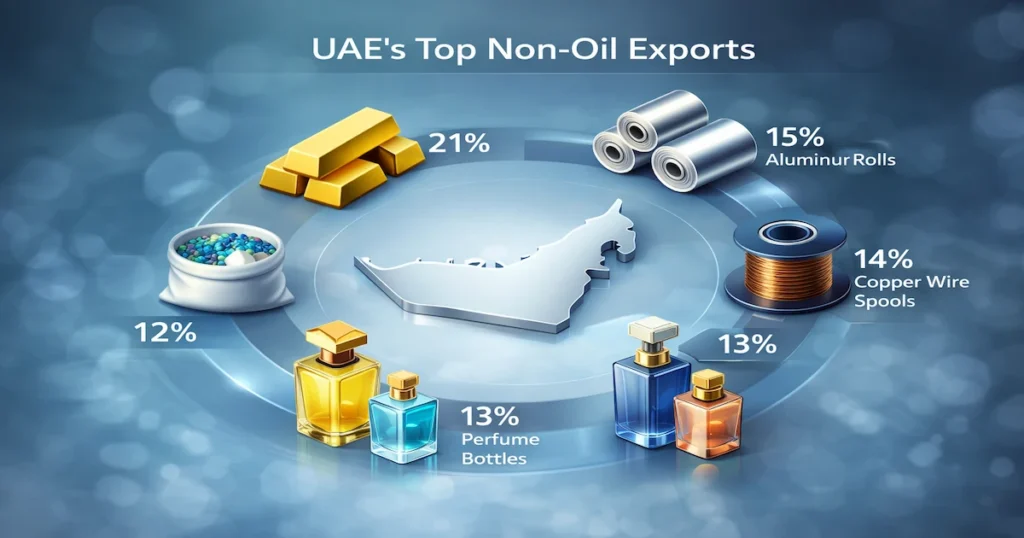
According to the breakdown of the 2025 trade data, the top performing UAE non-oil foreign trade included:
- Gold and Precious Jewelry: Leveraging Dubai’s status as the “City of Gold” to dominate value-added jewelry markets.
- Aluminum: A testament to the heavy industrial capabilities of entities like Emirates Global Aluminum (EGA).
- Copper Wires & Power Supplies: Feeding the global hunger for electrification and infrastructure.
- Polymers (Polypropylene): High-value petrochemical byproducts that serve the global manufacturing sector.
- Luxury Goods: Cigarettes, perfumes, and cosmetics continue to be high-volume movers.
Collectively, these non-oil export categories saw a growth of 64.5% compared to 2024 [Official Trade Data].
The “CEPA” Effect: Diplomacy Driving Dollars
A major driver behind this explosion in trade is the UAE’s aggressive pursuit of Comprehensive Economic Partnership Agreements (CEPAs). Over the past few years, the UAE has signed historic trade deals with key global players, including India, Turkey, Indonesia, and others.
These aren’t just pieces of paper; they are pipelines for capital. The data shows that trade with CEPA partners surged to AED 175.5 billion in 2025 alone. By lowering tariffs and removing trade barriers, the UAE has effectively integrated its economy with the fastest-growing markets in Asia and the Middle East.
This strategy of “economic diplomacy” has allowed UAE-based businesses to access millions of new consumers with a competitive advantage over rivals in Europe or the Americas.
A Record-Breaking Finale to 2025
The momentum did not slow down as the year progressed; in fact, it accelerated. The fourth quarter of 2025 (October to December) was historic in its own right.
- The Golden Quarter: For the first time, non-oil foreign trade exceeded AED 1 trillion in a single quarter.
- Q4 Growth: This represented a 33.1% increase compared to the same period in 2024.
- Export Velocity: Non-oil exports in Q4 alone stood at AED 234.4 billion, a figure that rivals the entire annual export volume of many smaller nations [Times of India].
The “We the UAE 2031” Vision
Understanding this news requires looking at the “We the UAE 2031” vision. Launched as a roadmap for the next decade, this plan aimed to double the national GDP and push foreign trade to AED 4 trillion by 2031.
Reaching AED 3.8 trillion in 2025 means the government now faces a “good problem”: they have smashed their targets too early. This early victory validates the government’s heavy investment in:
- Port Infrastructure: Jebel Ali and Khalifa Port continue to rank among the world’s most efficient.
- Digital Logistics: The adoption of blockchain and AI in customs processing has drastically reduced friction for traders.
- Free Zone Expansion: New regulations allowing 100% foreign ownership have attracted a wave of FDIs (Foreign Direct Investments).
What This Means for Global Business
For entrepreneurs and international businesses, the implications are clear:
- Stability: In a volatile region, the UAE offers a stable, diversified economy that is less reliant on the vagaries of oil prices than ever before.
- Access: The CEPA network means setting up shop in the UAE provides preferential access to massive markets like India and Turkey.
- Future-Proofing: The shift toward exporting copper, aluminum, and polymers aligns with the global trends of urbanization and electrification.
Conclusion
The headline is $1 trillion, but the story is resilience. By achieving 95% of its 2031 targets five years early, the UAE has proven that its economic diversification strategy is not just rhetoric—it is a reality. As the nation pivots from importing to manufacturing, and from oil reliance to trade dominance, it is setting a new blueprint for economic transformation in the Middle East.
The question is no longer if the UAE can survive without oil, but rather, how high can it fly on the wings of trade?