
In early February 2026, Washington and Dhaka concluded US Bangladesh Agreement on Reciprocal Trade (ART)—not a classic FTA with broad, permanent tariff elimination and a large legal architecture, but a targeted market-access pact that resets tariff treatment and creates conditional zero-duty lanes for certain Bangladeshi textile/apparel exports when specific U.S.-origin inputs are used.
For Liberty Trade Chronicles readers, the practical question is simple:
Does this make Bangladesh “cheaper vs. alternatives” in the U.S. market—and for which product lines, under what input rules, and with what compliance friction?
This deep dive breaks down what the US Bangladesh Agreement on Reciprocal Trade ART appears to do, what it likely does not do, and how buyers should re-run their landed-cost and vendor-allocation models.
1) ART vs. FTA vs. Preference Programs: what this deal structurally is
Traditional FTAs (e.g., USMCA, KORUS) typically include: broad tariff schedules, services chapters, IP, government procurement, dispute settlement, and detailed rules of origin (RoO). By contrast, the US Bangladesh Agreement on reciprocal trade ART framework—based on the official U.S. communications—reads more like a reciprocal market-access arrangement tied to a maintained tariff rate (19%) plus a carve-out list at 0% for specific products/conditions rather than economy-wide tariff dismantling. (The White House)
Key takeaway:
- You should model ART as a “tariff regime change + conditional preference lane,” not as a full FTA that automatically liberalizes most categories.
2) The headline mechanics: 19% reciprocal tariff rate + zero-duty carve-outs
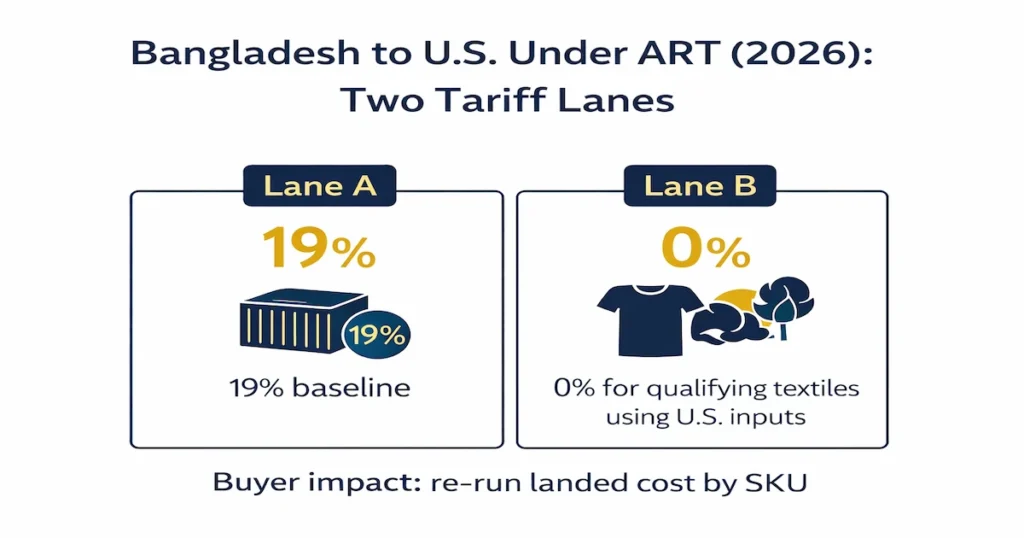
A) The “19%” ceiling
USTR’s fact sheet states the U.S. will maintain a 19% reciprocal tariff rate for imports from Bangladesh, with exceptions for identified products that can receive 0% treatment.
This matters because a predictable ceiling can be more valuable than a volatile peak—especially after the recent period of sharply higher tariff treatment referenced in reporting.
B) Conditional 0% for select textiles/apparel using U.S. inputs
Multiple reports (and Reuters) describe a core feature: some Bangladeshi garment exports can qualify for zero duty if made with U.S.-origin textile inputs (e.g., cotton / man-made fibers).
Interpretation (practical, buyer-side):
- This is effectively a “yarn-forward / input-origin incentive”: Bangladesh keeps its manufacturing edge, while the U.S. tries to pull upstream demand toward American fiber and textiles.
3) Why this is built on TICFA (and why TICFA still matters)
The US Bangladesh Agreement on Reciprocal Trade ART builds on existing bilateral economic architecture such as TICFA (Trade and Investment Cooperation Forum Agreement), signed earlier and used as an ongoing platform for trade and investment dialogues.
Why this matters:
- TICFA is the plumbing—a forum mechanism that makes it easier to negotiate and iterate.
- ART is the tariff/market-access lever—the part that immediately changes landed cost and sourcing decisions.
4) What actually changes for apparel sourcing: the “two-lane Bangladesh” model
Think of Bangladesh now having two tariff lanes into the U.S.:
Lane 1 — Standard ART lane (19%)
- Most Bangladeshi exports face a 19% tariff (as framed by USTR).
Buyer implication: Your Bangladesh cost base improves vs. a higher-tariff world, but it’s not duty-free.
Lane 2 — Preferential ART lane (0%) for qualifying products
- Certain textiles/apparel can go 0% if they meet the U.S.-input condition described in reporting.
Buyer implication: This lane can be a margin weapon—but only if your product + BOM (bill of materials) + documentation can survive customs verification.
5) The hard part: rules-of-origin discipline and documentation risk
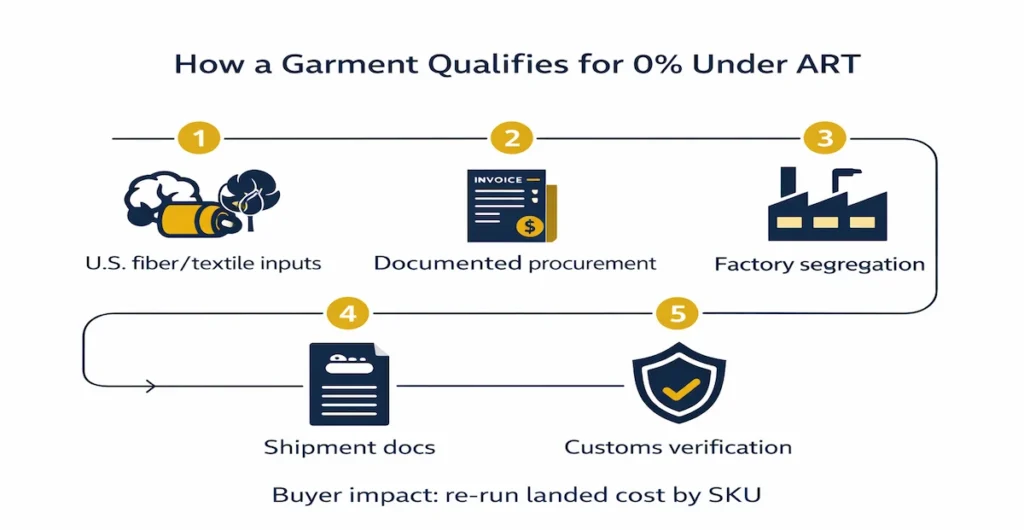
A conditional zero-duty lane is only as good as:
- Input traceability (proof of U.S.-origin cotton/fiber/yarn/fabric, depending on the rule),
- Chain-of-custody documentation (commercial invoices, mill test certificates, yarn invoices, supplier declarations),
- Factory segregation (keeping U.S.-input production separated from non-qualifying lines), and
- Customs audit readiness.
This is where many sourcing teams miscalculate. The correct question is not “Can we get 0% duty?” but:
What is the net benefit after higher U.S.-input costs + compliance overhead + audit risk?
6) Landed cost math: a simple decision framework (buyers can actually use)
Use this quick framework to decide where ART is immediately actionable:
Step A — Classify your product lines
- Basics / high-volume items (T-shirts, underwear, simple knits): more price-sensitive, but easier to standardize input sourcing.
- Fashion / short runs: harder to re-engineer BOMs to meet origin rules quickly.
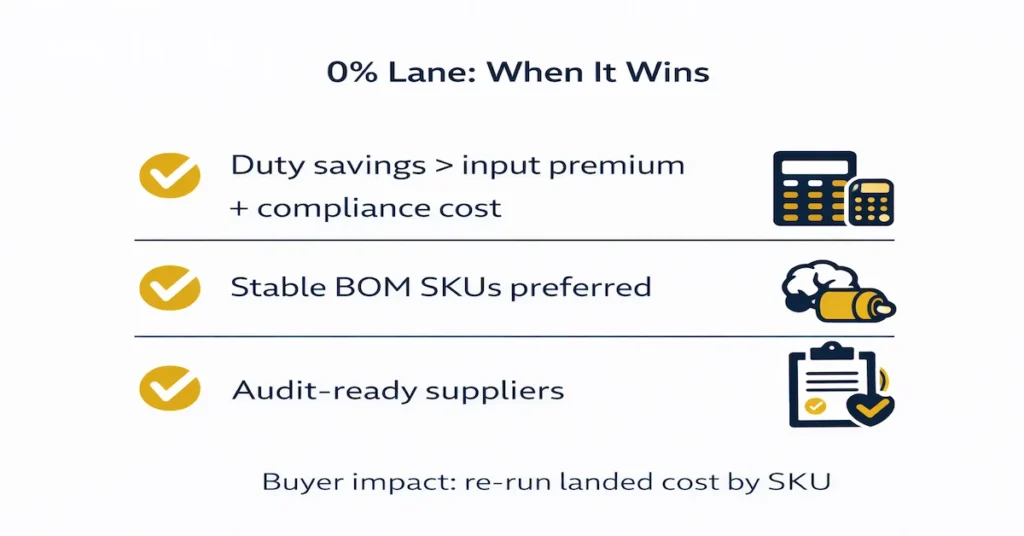
Step B — Estimate the “U.S.-input premium”
If U.S. cotton/yarn/fabric costs more than your current inputs, the premium might eat part of the duty advantage.
Step C — Compare net landed cost (illustrative logic)
- Without 0% lane: Pay 19% duty (Lane 1).
- With 0% lane: Pay 0% duty but accept input premium + compliance.
If your duty savings > (input premium + compliance cost), the 0% lane wins.
7) Strategic winners and watchpoints
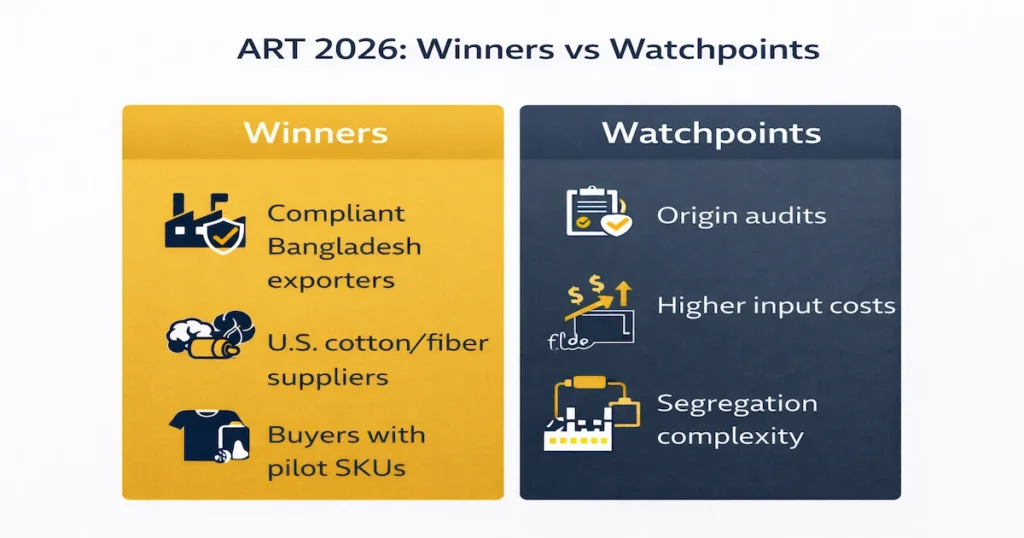
Likely winners
- Bangladesh garment exporters that can quickly integrate U.S. cotton/man-made fiber supply and prove it (compliance-ready factories). (Reuters)
- U.S. upstream suppliers (cotton and man-made fibers) benefiting from “pulled-through” demand. (The Economic Times)
- U.S. buyers who can restructure vendor programs around qualifying SKUs to capture duty savings.
Watchpoints (don’t ignore these)
- Eligibility complexity: conditional deals tend to create uneven access—some factories win, others are locked out.
- Verification/audits: if claims fail, duty can be reassessed retroactively (risk = surprise margin loss).
- Operational friction: factories may need BOM discipline they aren’t used to enforcing.
8) What this signals geopolitically—without the hype
US Bangladesh Agreement on Reciprocal Trade ART fits a broader pattern: market access is being exchanged for supply-chain alignment (here: U.S. inputs). This is less about “free trade ideology” and more about directing value-chain flows with measurable procurement hooks. The Reuters reporting also frames the deal as meaningful for Bangladesh’s garment sector at a fragile moment.
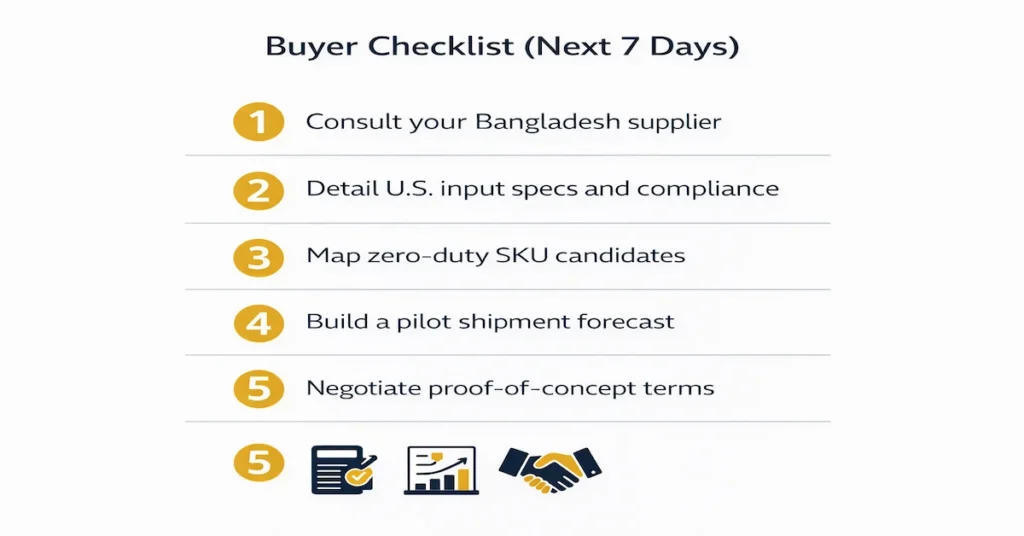
9) What you should do this week (Buyer Action Checklist)
If you source apparel from Bangladesh (or are considering shifting from other Asian bases):
- Ask suppliers if they can run a U.S.-input production line (yes/no, timeline, minimum order quantities).
- Request a “qualification pack” template: supplier declarations + upstream invoices + origin statements.
- Pick 3–5 “pilot SKUs” (high volume, stable BOM) for the 0% lane test.
- Re-run your landed cost model with two scenarios:
- Scenario 1: 19% duty
- Scenario 2: 0% duty + higher input costs + compliance cost
- Align with your customs broker now (don’t wait until shipment).
10) FAQ
Is ART the same as an FTA?
No. US Bangladesh Agreement on Reciprocal Trade ART is framed as a reciprocal trade arrangement with a maintained tariff rate and specific zero-duty carve-outs rather than a broad FTA-style tariff elimination architecture.
Do all Bangladeshi garments become duty-free?
No. Reporting and USTR materials indicate 0% applies to identified products/conditions, while the broader tariff rate is 19%.
What’s the biggest operational risk?
Origin compliance—proving U.S. inputs and maintaining documentation readiness end-to-end. (Operational inference based on how conditional preference regimes function; validate with your broker and legal counsel.)