
The EU US Trade Tariff Implementation Agreement marks an important step in stabilizing trade relations between the European Union and the United States. The European Parliament and the Council have now reached a provisional agreement to implement the tariff components of the broader EU-US Joint Statement, shifting the framework from political negotiation into operational trade policy.
For importers, exporters, and procurement teams, this matters because the agreement begins translating political commitments into enforceable customs treatment. In practice, that is where trade frameworks either become commercially useful or collapse under compliance friction.
From a sourcing perspective, the EU US Trade Tariff Implementation Agreement matters less because of diplomatic signaling and more because it could restore medium-term predictability for industrial supply chains. Over the last two years, many buyers quietly widened inventory buffers, delayed supplier transitions, and slowed procurement restructuring because tariff policy between the EU and US became politically unstable rather than commercially predictable.
What buyers often underestimate is that tariff relief does not automatically reduce landed costs. Customs guidance, rules-of-origin verification, derivative product definitions, quota administration, and supplier documentation ultimately determine whether importers can actually capture the theoretical savings.
Table of Contents
- EU US Trade Tariff Implementation Agreement Overview
- What Happened
- What This Agreement Is — And What It Is Not
- Buyer Impact
- Operational Reality
- Strategic Implications
- Scenario Outlook
- Buyer Action Checklist
- FAQ
- Sources & References
EU US Trade Tariff Implementation Agreement Overview
The implementation phase of the EU US Trade Tariff Implementation Agreement now shifts attention away from political negotiations and toward customs enforcement, sourcing strategy, and operational compliance. For buyers, the challenge is no longer understanding the headline agreement itself — it is determining whether tariff savings can survive customs scrutiny and supplier documentation requirements.
What Happened
The European Parliament and EU member states reached a provisional legislative agreement to implement the tariff-related provisions of the EU-US Joint Statement negotiated in 2025. The objective is to prevent another tariff escalation cycle while formalizing reciprocal tariff concessions already partially implemented by the United States.
(Source: <a href=”https://www.reuters.com/business/eu-paves-way-finalise-us-trade-deal-avoid-trump-tariff-hike-2026-05-20/”>Reuters</a>)
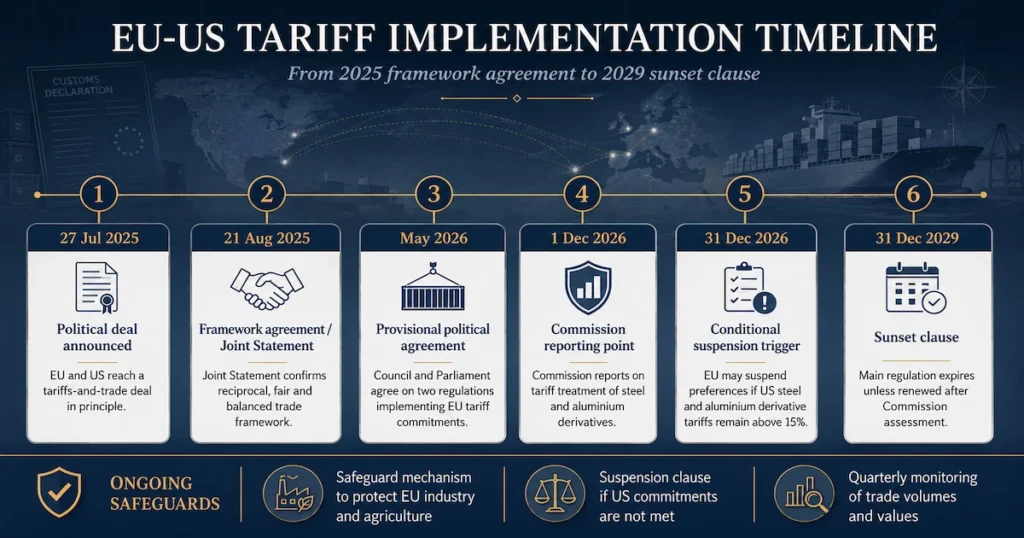
The agreement reportedly includes:
- Reduction or elimination of tariffs on many US industrial goods entering the EU
- Safeguard mechanisms allowing tariff preferences to be suspended
- Sunset provisions ending the framework by 2029 unless renewed
- Conditional responses tied to US treatment of steel and aluminum tariffs
- Continued tariff-free treatment for selected products such as US lobster exports
(Source: <a href=”https://www.ft.com/content/a08e5619-6bd2-4e2c-9393-c6dd7e8f2a17″>Financial Times</a>)
The arrangement forms part of a broader attempt to stabilize a transatlantic trade relationship valued at roughly $2 trillion annually.
(Source: <a href=”https://www.reuters.com/business/eu-paves-way-finalise-us-trade-deal-avoid-trump-tariff-hike-2026-05-20/”>Reuters</a>)
What This Agreement Is — And What It Is Not
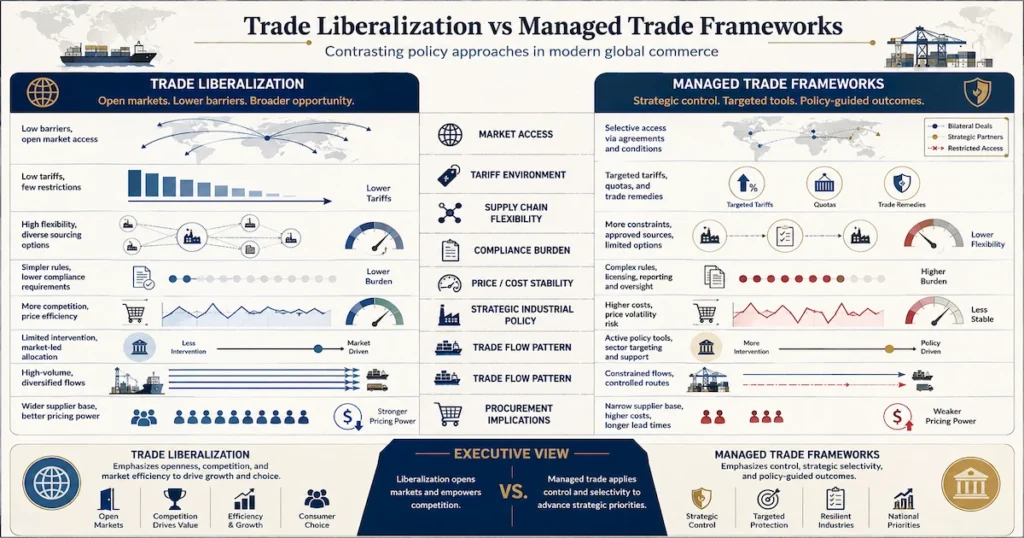
The EU US Trade Tariff Implementation Agreement is not a traditional free trade agreement comparable to a fully ratified FTA.
Instead, it functions more as a managed trade stabilization framework designed to contain tariff escalation while allowing both sides to preserve leverage in politically sensitive sectors.
That distinction matters commercially.
Traditional FTAs usually provide:
- Long-term tariff schedules
- Binding dispute mechanisms
- Comprehensive rules-of-origin frameworks
- Stable implementation timelines
- Greater legal certainty
This framework appears more conditional, sector-specific, and politically reversible.
On paper, tariff reductions improve predictability. On the ground, buyers still face uncertainty because sensitive sectors remain exposed to future negotiations, safeguard actions, and quota systems.
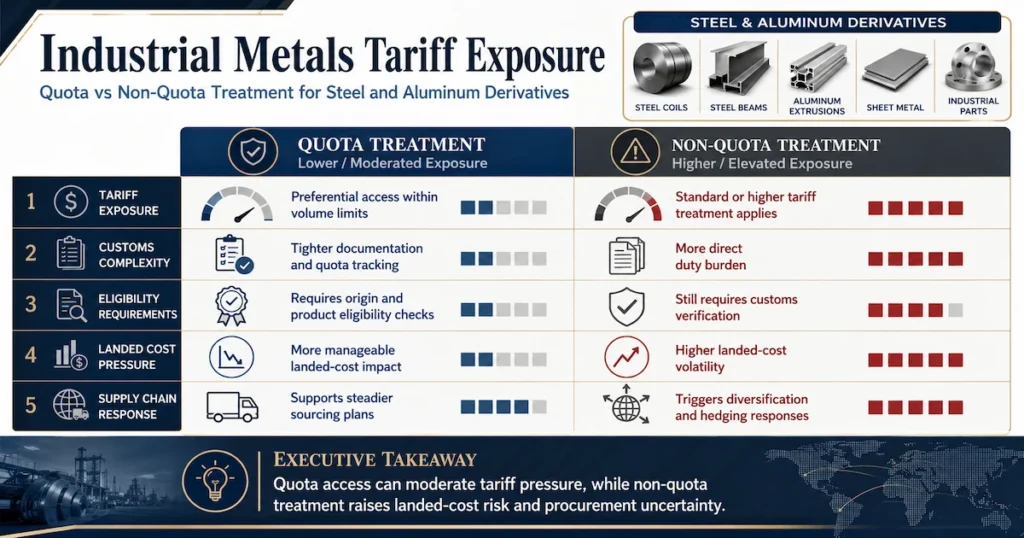
The steel and aluminum provisions remain especially important because products outside quota structures may still face elevated tariff exposure.
(Source: <a href=”https://www.wto.org/english/tratop_e/tariffs_e/tariffs_e.htm”>World Trade Organization</a>)
Buyer Impact
EU US Trade Tariff Implementation Agreement Buyer Impact
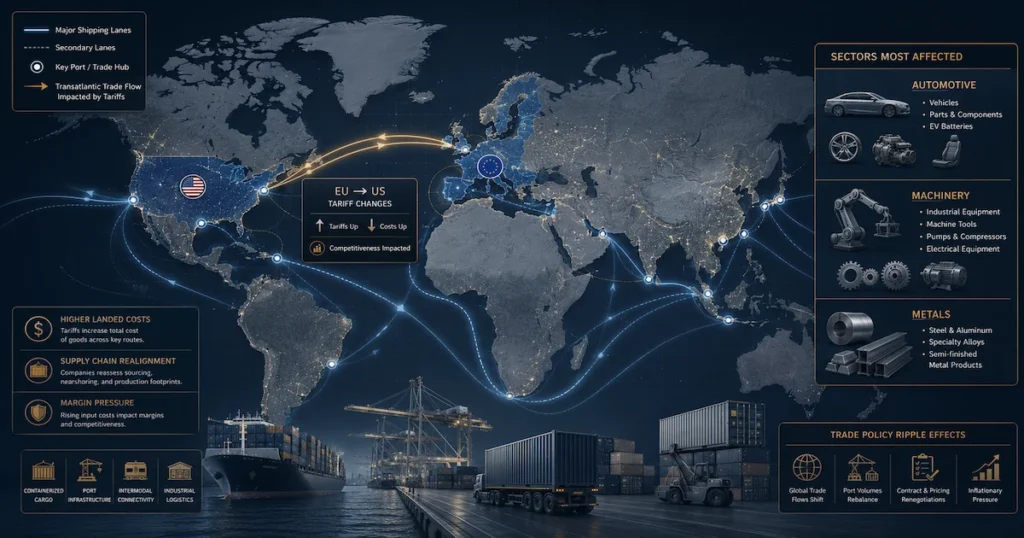
For multinational procurement teams, the EU US Trade Tariff Implementation Agreement creates both tariff opportunities and compliance risks that must be evaluated together.
Industrial Machinery
US industrial exporters may gain modest pricing advantages inside Europe if tariffs decline on selected machinery categories.
That could influence sourcing decisions involving:
- Industrial pumps
- Factory automation systems
- Aerospace components
- Specialized tooling
- Electrical equipment
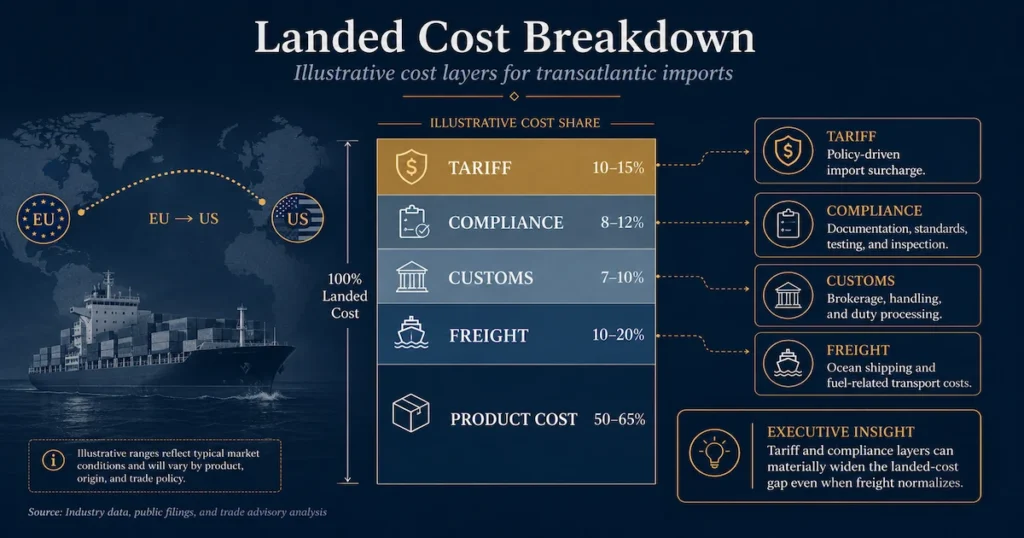
However, landed-cost calculations still depend heavily on:
- Freight volatility
- VAT treatment
- Currency movement
- Certification costs
- Export-control restrictions
Tariffs remain only one component of the sourcing equation.
A German machinery importer sourcing forged steel components from Ohio may still face derivative classification uncertainty if downstream processing occurs in Mexico before final EU entry. That operational ambiguity often matters more than headline tariff reductions.
Automotive Supply Chains
The automotive sector remains politically sensitive on both sides of the Atlantic.
Even if tariff conditions improve temporarily, procurement teams still face:
- Battery sourcing localization rules
- Critical minerals restrictions
- Carbon reporting obligations
- CBAM exposure
- National subsidy distortions
Where this often breaks down operationally is supplier qualification timing. Automotive OEMs cannot redesign sourcing structures every year around changing tariff politics.
As a result, many buyers will likely maintain dual-source strategies despite the agreement.
Agriculture and Food Inputs
The EU reportedly expanded market access for selected US agricultural exports.
(Source: <a href=”https://www.reuters.com/business/autos-transportation/whats-trumps-trade-deal-with-europe-2025-07-27/”>Reuters</a>)
But agricultural implementation is rarely frictionless.
European sanitary and phytosanitary controls remain politically sensitive and heavily audited. Exporters often underestimate:
- Labeling obligations
- Traceability requirements
- Veterinary certifications
- Sustainability documentation
- Pesticide residue compliance
Market access on paper does not guarantee scalable shelf access in practice.
Operational Reality
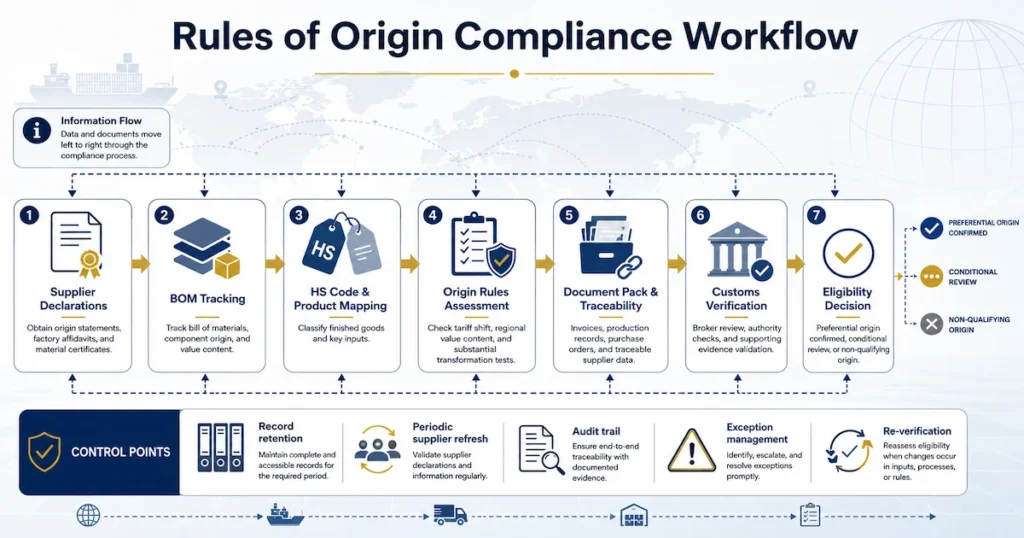
The operational success of the EU US Trade Tariff Implementation Agreement will depend heavily on documentation discipline, origin verification, and supplier readiness.
Rules of Origin Complexity
Preference utilization depends on proving qualifying origin.
That becomes difficult in supply chains where:
- Components cross borders multiple times
- Bills of material change frequently
- Contract manufacturers source regionally
- HS classifications differ across jurisdictions
Even sophisticated importers struggle to maintain accurate origin substantiation across multi-tier suppliers.
A tariff preference that cannot survive customs verification is commercially dangerous.
Supplier Documentation Discipline
Many mid-market manufacturers still lack mature origin-management systems.
Buyers may now require:
- Supplier declarations
- Long-term origin certificates
- Production traceability records
- Component-level sourcing data
- Manufacturing process mapping
Ironically, some larger importers may benefit more from compliance complexity than tariff relief itself because smaller competitors often lack the systems required to claim preferential treatment.
Safeguard Risk
The agreement includes suspension mechanisms and sunset provisions.
(Source: <a href=”https://www.ft.com/content/a08e5619-6bd2-4e2c-9393-c6dd7e8f2a17″>Financial Times</a>)
That means tariff certainty remains conditional.
If geopolitical tensions rise again, buyers could face:
- Reinstated duties
- Emergency safeguard actions
- Revised sector carve-outs
- Expanded derivative definitions
Procurement teams should avoid assuming permanence.
CBAM and ESG Interaction
The broader framework reportedly references flexibility around:
- CBAM
- CSDDD
- CSRD
- EUDR implementation burdens
(Source: <a href=”https://policy.trade.ec.europa.eu/index_en”>European Commission</a>)
However, implementation flexibility does not eliminate compliance exposure.
For more on carbon-border exposure, see our <a href=”/cbam-compliance-guide/”>CBAM compliance guide</a>.
In practice, ESG documentation burdens will likely remain substantial for industrial exporters.
Strategic Implications
The EU US Trade Tariff Implementation Agreement reinforces a broader shift toward politically managed trade rather than fully liberalized trade systems.
The sourcing model of the 2000s assumed:
- Expanding tariff liberalization
- Predictable WTO frameworks
- Stable MFN treatment
- Gradual market convergence
The current environment increasingly favors:
- Strategic industrial policy
- Sector-based protection
- Conditional tariff relief
- Security-linked trade access
- Regionalized sourcing resilience
According to the <a href=”https://www.wto.org/”>World Trade Organization</a>, tariff frameworks are increasingly shifting toward regionalized trade structures.
Scenario Outlook
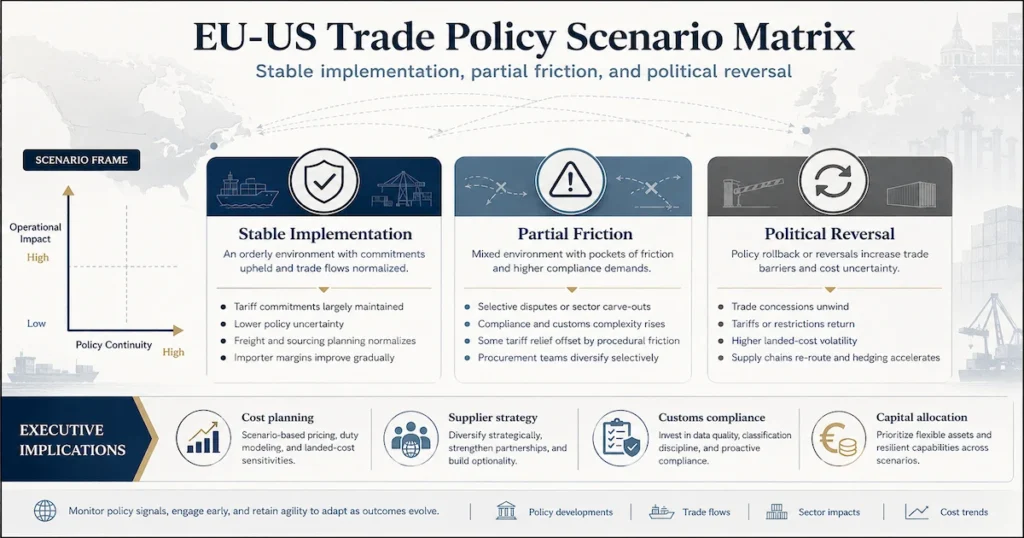
Scenario 1: Stable Implementation
If implementation proceeds smoothly:
- Industrial sourcing confidence improves
- Inventory buffers normalize
- Capital spending resumes gradually
- EU-US trade volumes strengthen modestly
Scenario 2: Partial Compliance Friction
A more likely outcome involves:
- Customs interpretation disputes
- Administrative bottlenecks
- Slow preference utilization
- Sector carve-out disagreements
Under this scenario, larger importers with mature trade-compliance systems capture most of the benefits.
Scenario 3: Political Reversal
The sunset and suspension mechanisms create long-term political reversibility.
If transatlantic tensions rise again:
- Safeguards may reactivate
- Tariffs may return
- Quota systems may tighten
Buyers with concentrated sourcing exposure remain vulnerable.
Buyer Action Checklist
- Recalculate landed-cost models assuming partial rather than full tariff relief
- Review HS classifications tied to industrial goods and derivative products
- Audit supplier origin documentation capability
- Stress-test sourcing exposure to safeguard reinstatement
- Monitor steel and aluminum derivative treatment closely
- Evaluate dual-source resilience for politically sensitive sectors
- Update customs broker instructions for preference claims
- Build sourcing scenarios around 2029 sunset exposure
FAQ
Does this eliminate all EU-US tariffs?
No. The framework remains sector-specific and conditional. Several politically sensitive sectors still face quota management or safeguard exposure.
(Source: <a href=”https://www.ft.com/content/a08e5619-6bd2-4e2c-9393-c6dd7e8f2a17″>Financial Times</a>)
Will importers immediately see lower landed costs?
Not necessarily. Customs implementation, freight economics, origin qualification, and compliance documentation still determine effective savings.
Why are sunset clauses important?
Because they reduce long-term certainty. Buyers making multi-year sourcing decisions must account for the possibility that tariff preferences expire or become suspended.
Does this replace WTO structures?
No. The framework operates alongside existing WTO mechanisms but reflects a more managed bilateral trade approach.
Which industries benefit most?
Industrial machinery, selected manufacturing sectors, and some agricultural exporters may benefit first. Metals remain considerably more complicated.
Final Editorial Assessment
Ultimately, the long-term commercial value of the EU US Trade Tariff Implementation Agreement depends less on headline tariff reductions and more on practical implementation across supply chains.
This agreement matters because it lowers the probability of another immediate EU-US tariff escalation cycle. That alone has commercial value.
But the market should not confuse stabilization with liberalization.
In practice, the framework introduces a managed trade structure layered with safeguards, conditionality, compliance obligations, and political reversibility. Sophisticated importers with strong customs governance may benefit meaningfully. Smaller operators without mature origin-management systems may struggle to capture the theoretical tariff savings.
The upside is real, but only for companies prepared to operationalize the agreement rather than simply react to the headlines.
SOURCES & REFERENCES
- <a href=”https://www.consilium.europa.eu/en/press/press-releases/2026/05/20/eu-us-trade-council-and-parliament-strike-a-deal-to-implement-the-tariff-elements-of-the-joint-statement/”>Consilium – EU-US Trade Joint Statement Implementation</a>
- <a href=”https://www.reuters.com/business/eu-paves-way-finalise-us-trade-deal-avoid-trump-tariff-hike-2026-05-20/”>Reuters – EU paves way to finalize US trade deal and avoid tariff hike</a>
- <a href=”https://www.ft.com/content/a08e5619-6bd2-4e2c-9393-c6dd7e8f2a17″>Financial Times – EU lawmakers strike deal on US trade pact</a>
- <a href=”https://www.reuters.com/business/autos-transportation/whats-trumps-trade-deal-with-europe-2025-07-27/”>Reuters – What’s in Trump’s trade deal with Europe?</a>
- <a href=”https://policy.trade.ec.europa.eu/index_en”>European Commission Trade Directorate</a>
- <a href=”https://www.wto.org/english/tratop_e/tariffs_e/tariffs_e.htm”>WTO Tariff Framework Documentation</a>